Scammers are always one step ahead. No matter how advanced our technology gets or how strong our fraud detection systems become, criminals keep finding new gaps to exploit. One of their most clever tricks today is the reshipping scam, a scheme that lets fraudsters stay completely hidden while making money behind the scenes.
And this is not a small or rare problem. Studies show that some reshipping operations run like full businesses. In one documented case, a single criminal network managed to ship nearly 6,000 packages in just nine months, pulling in more than $7.3 million every year.
So what exactly is a reshipping scam, and how can your business avoid falling victim to one without even knowing it? This guide breaks it all down in plain, simple terms.
Let’s get started with understanding what reshipping scams are and how they work, then walk through a downloadable checklist you can use to protect your business.
What Are Reshipping Scams?
Imagine receiving a job offer to “handle packages from home.” It sounds simple, where one receives deliveries and forwards them to another address.
What you don’t know is that those packages were purchased using stolen credit cards.
This is how a reshipping scam works. Fraudsters use someone else’s address and identity, using fake job offers to move stolen goods. The real buyer is invisible, the address circles back to the mule, and the scammer profits quietly in the background.
Overall, reshipping scams are estimated to drive around $1.8 billion in losses every year.
What looks like a simple delivery job is often part of a much larger fraud ecosystem.
How Reshipping Scams Work?
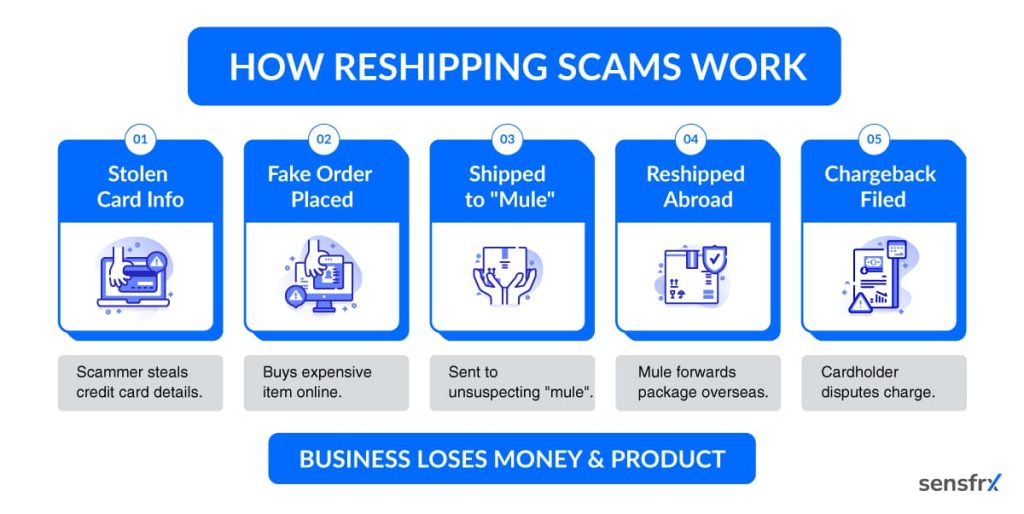
- Step 1: Stolen Card in Hand: Fraudsters obtain stolen credit card details through data breaches, phishing, or the dark web, ready to make purchases without the real cardholder knowing.
- Step 2: Fake Job Ad Goes Live: They post convincing work-from-home job ads looking for a “package handler” or “shipping coordinator.” An innocent person applies, unknowingly becoming the mule.
- Step 3: High-Value Order Placed: The fraudster uses the stolen card to place a high-value order on an e-commerce store, shipping it to the mule’s real, legitimate home address, making the order look completely genuine.
- Step 4: Package Arrives at the Mule’s Address: The mule receives the package, believing it’s part of their new job. The delivery address is real, residential, and passes most fraud checks.
- Step 5: Mule Forwards the Package: Following instructions, the mule reships the package to another location, usually overseas, where the actual fraudster or their network collects it.
- Step 6: Scammer Resells the Goods: The fraudster resells the goods on marketplaces such as eBay, Facebook, or local platforms, converting stolen goods into clean cash.
- Step 7: Real Cardholder Notices and Files a Chargeback: The legitimate card owner spots the unauthorized charge and disputes it with their bank, triggering a chargeback against the merchant.
The business takes the full hit by the time the chargeback lands; the product is long gone. The merchant loses the goods, the payment, pays chargeback fees, and their fraud score suffers with payment processors, while the scammer remains completely hidden.
Red Flags for Businesses and Job Seekers
The victims in a reshipping fraud are the businesses from where the product is bought using a stolen card, and the shipping assistant, also called the mule, who has been hired to reship the product.
Here are the key warning signs for the businesses:
Order & Customer Behavior
Customer behavior usually follows a pattern when shopping online. For example, buying one phone occasionally is normal but placing large orders of expensive items can be unusual and may signal risk.
Some behaviors might look normal but are not:
o A first-time customer placing a high-value order (phones, electronics, bulk items)
o Multiple orders in a short time from the same account or IP
o Unusual buying patterns, like purchasing only expensive, easy-to-resell items
Address & Shipping Signals
A mismatch between the billing and shipping address can indicate potential fraud and is a key signal in eCommerce fraud prevention strategies. Common red flags include:
o Billing and shipping addresses don’t match.
o New or rarely used shipping address.
o Same address on many customer accounts.
o Delivery to freight forwarders, warehouses, or temp spots.
Payment Red Flags
Scammers often use stolen cards, so they may try several cards before finding the one that actually works. Watch for these signs of fraud:
o International card with a local shipping address.
o Multiple failed attempts before success.
Behavioural & Technical Signals
They help spot suspicious activity by looking at how a customer behaves online, also called behavioral fraud detection that are:
o Location doesn’t match: The order comes from one country, but the delivery address is somewhere else.
o Hidden identity tools: The person may be using tools (like VPNs) to hide their real location or device.
o Repeated small changes: Multiple orders with small differences (like different card numbers) to test which stolen card works.
Here are the key warning signs for job seekers:
- They are asked to share personal information over the phone to get the job
- The “employer” wants to run a credit check before hiring
- The job or company is hard to find online
- A quick search shows negative reviews or scam reports
- The same job ad appears for different companies or locations
- The company has no proper website or contact details
Prevention Checklist for Merchants
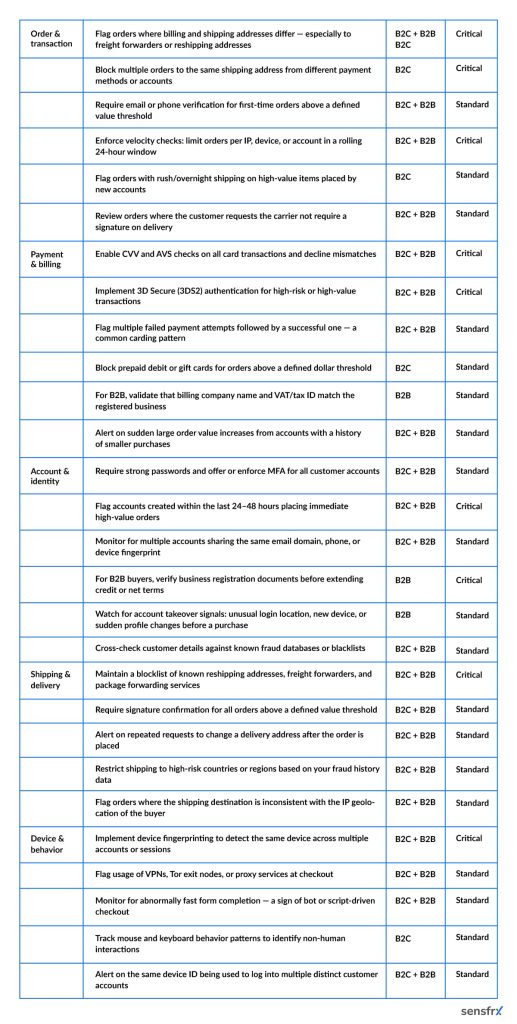
It is important for the merchants to ensure that their ecommerce business doesn’t get trapped in the circle of reshipping scams. And as we have already highlighted the red flags a more practical approach will be to incorporate checks that can help identify red flags and block the scams before it happens.
The table below is a checklist to help you prepare an action plan for preventing reshipping scams:
Top Tools to Block Reshipping Fraud
The checklist above tells you what to look for manually. The tools below automate those exact same checks at scale, so you’re not relying on a human to catch every red flag on every order, since this is not always possible.
The tools listed below are chosen specifically because they address these signals, not just surface-level card checks.
1. Sensfrx
Best for: E-commerce, healthcare, travel, and crypto businesses
An AI-powered fraud prevention platform that uses 200+ signals, has screened over 1.6 million events, and reduces manual screening by 65%.
- Real-time AI risk scoring blocks bots, fake accounts, and payment fraud
- Device fingerprinting, IP/email verification, and geo-location change detection
- Up to 150 customizable risk rules with blacklist/whitelist management
- Covers the full customer journey from registration to checkout
- Instant alerts, fraud trend dashboard, and manual review queue
- Transparent pricing with free plan and 30-day trial
2. SEON
Best for: Mid-market merchants wanting modular, API-first detection
Enriches email, phone, IP, and device data using dozens of external signals to detect fraud before checkout.
- Social + device + IP digital footprint analysis
- Configurable rules engine with transparent risk scoring
- Low false positive rate with high customizability
3. NoFraud
Best for: Shopify merchants wanting fully automated fraud management
Blocks mule-linked orders before authorization even when addresses and billing details look legitimate.
- Real-time Pass/Fail decisions with zero merchant input needed
- Live cardholder verification for high-risk orders
- 100% chargeback guarantee on covered orders
4. FraudLabs Pro
Best for: Small merchants needing budget-friendly, customizable screening
Validates orders against a fraud database, checks proxy/VPN usage, and assigns a clear Approve/Review/Reject recommendation.
- 20+ ready-made plugins for all major e-commerce platforms
- Custom rules alongside automated risk scoring
- SMS/OTP verification add-on for high-risk transactions
5. Signifyd

Best for: Growing merchants wanting a financial chargeback guarantee
Uses machine learning on real-time order data to approve more orders confidently without increasing fraud risk.
- 100% financial liability shift on all approved orders
- Identity network of 1.2B+ buyer profiles
- Self-improving ML models that get smarter with every order
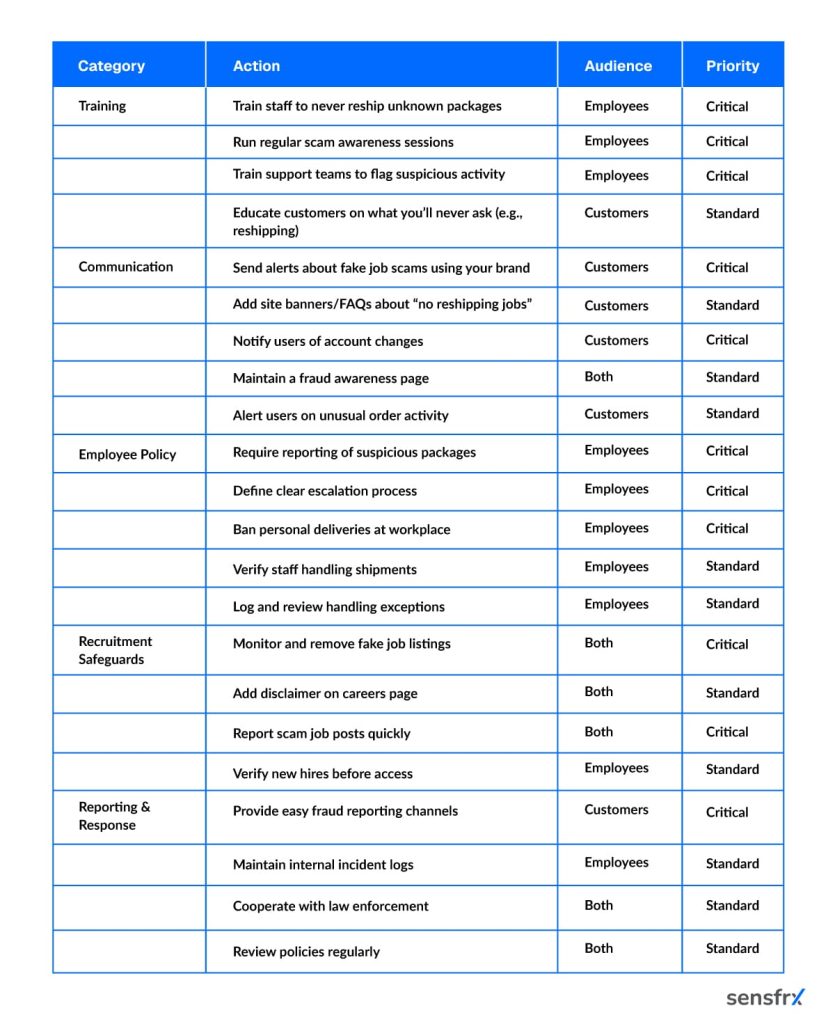
Protecting Customers & Employees (Checklist)
Businesses can reduce reshipping scams, reduce internal risks, and improve awareness by following the checklist below. However, for complete protection, these measures should be paired with real-time fraud detection systems.
What If You’re a Victim? (Reporting & Recovery)
For Merchants
- Secure your accounts first — Reset all admin, payment gateway, and platform credentials immediately. Revoke unknown API keys, revoke third-party access, and enable MFA for everything.
- Document everything — Preserve order records, shipping confirmations, IP logs, and all communications with the fraudulent buyer. Do not delete anything; this is your evidence package.
- Dispute chargebacks — Contact your payment processor or acquiring bank right away. Submit documented evidence (order details, IP data, delivery confirmation) to contest fraudulent chargebacks within your processor’s dispute window (usually 7–30 days).
- File with IC3 — Submit a complaint to the FBI’s Internet Crime Complaint Center at ic3.gov. Include order IDs, dollar amounts, shipping addresses used, and any account or email data tied to the fraud.
- Report to the FTC — File at ReportFraud.ftc.gov. Include details of any fake job ads using your brand name. The FTC uses merchant data to identify wider patterns and support investigations.
- Contact your cybercrime unit — File with local police and request escalation to their cyber or economic crime unit. For cross-border fraud, also notify your national cybercrime authority (CISA in the US, Action Fraud in the UK, CERT-In in India).
- Notify your shipping carrier — Alert UPS, FedEx, USPS, or whoever you use about fraudulent shipments. Request interception or return where possible; most carriers have internal fraud teams.
- Warn your customers — If your brand was used in fake job recruitment or customer data was exposed, send a proactive email. Transparency protects your reputation and helps victims identify the scam.
- Review and harden — After the incident, audit all fraud controls to find the gap that was exploited. Update risk scores, blocklists, and velocity rules. Consider a third-party fraud audit if losses were significant.
Key Takeaways
Reshipping scams can happen to any business, often without warning. Here’s what to keep in mind:
- Reshipping scams are a direct revenue risk — they lead to chargebacks, product loss, and chargeback fees, not just isolated incidents.
- A legitimate-looking order isn’t a safe order — real addresses and valid card details don’t rule out fraud when a mule is in the middle.
- Shipping address ≠ customer identity — delivery addresses are unreliable trust signals when reshippers act as intermediaries.
- Traditional checks aren’t enough — IP rules, basic velocity checks, or OTP verification alone won’t catch fraud that’s specifically designed to look normal.
- Late detection means guaranteed loss — once goods are shipped, recovery is rare. Prevention must happen before fulfillment, not after.
- A layered approach is the only reliable defense — combining device fingerprinting, address intelligence, behavioral analysis, and real-time risk scoring closes the gaps that single-layer tools leave open.
Reshipping scams are getting smarter and harder to catch, and no single check, rule, or tool will stop them alone. The businesses that stay protected are the ones that layer their defenses: combining device fingerprinting, behavioral analytics, address intelligence, and real-time risk scoring so that even when one signal looks clean, the full picture tells the truth. The checklist and red flags in this guide are a strong starting point, but manual vigilance only goes so far. At scale, prevention has to be automated, proactive, and built to detect signals that appear normal on the surface.
That’s where the right fraud prevention platform makes a measurable difference. Sensfrx analyses 200+ signals across device, behavior, location, and transaction data simultaneously, in real time, before an order is fulfilled. It reduces manual review by 65%, keeps false positives low so legitimate customers aren’t blocked, and covers the full customer journey from registration to checkout. If reshipping fraud is a risk your business can’t afford to absorb, you can try Sensfrx’s free plan and register today.
Frequently Asked Questions (FAQs)
What is a reshipping scam, and how does it affect businesses?
Reshipping scams involve fraudsters using intermediaries to receive and forward goods purchased with stolen payment details, leading to chargebacks, product loss, and operational risk for businesses.
How can businesses identify reshipping fraud early?
Early signs include multiple accounts linked to the same device, repeated use of similar shipping addresses, unusual ordering patterns, and mismatched billing and delivery details.
Why do traditional fraud checks fail against reshipping scams?
Because fraudsters use different identities, IPs, and addresses, making each transaction appear legitimate. Traditional checks often miss the underlying connection between them.
What role does device fingerprinting play in preventing reshipping scams?
Device fingerprinting helps link multiple accounts and transactions to the same underlying device, revealing hidden fraud patterns that are otherwise difficult to detect.