Occupational fraud causes organizations to lose an estimated 5% of annual revenue each year, according to the Association of Certified Fraud Examiners (ACFE). Yet not every fraud risk deserves the same level of attention.
A fraud risk assessment framework helps organizations identify where fraud is most likely to occur, measure its potential business impact, and prioritize controls based on evidence rather than assumptions.
This guide walks you through a practical fraud risk assessment framework right from defining scope and identifying fraud risks to evaluating controls, prioritizing mitigation efforts, and continuously monitoring emerging threats.
You’ll also find risk scoring models, assessment templates, examples, and implementation best practices that you can adapt to your organization’s fraud risk management program.
Established Frameworks for Fraud Risk Assessment
Several established frameworks guide fraud risk management, each addressing a different aspect of the assessment process. Rather than following a single standard end-to-end, organizations often combine elements from multiple frameworks to build a methodology that aligns with their risk profile, regulatory obligations, and business model.
The table below summarizes where each framework adds the most value within the fraud risk assessment process.
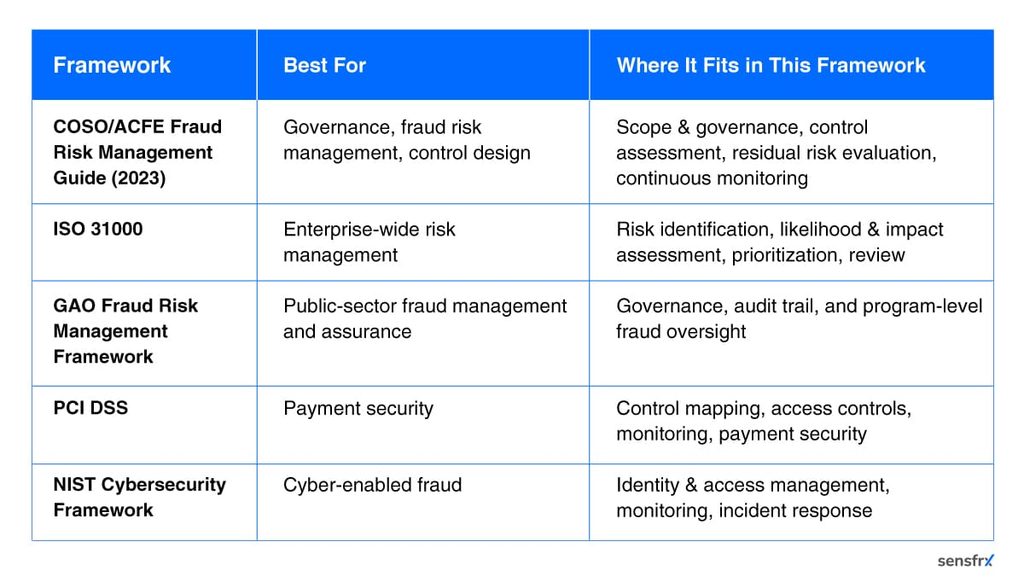
This piece doesn’t replace those. It applies their structure to a faster-moving, transaction-heavy environment, and fills in the scoring and monitoring detail they leave abstract.
How Industry Standards Strengthen Your Fraud Risk Assessment?
A fraud risk assessment framework doesn’t have to rely on a single standard. Many organizations combine multiple frameworks to strengthen different stages of the assessment process.
- COSO/ACFE Fraud Risk Management Guide (2023): Establish governance, define responsibilities, evaluate controls, and monitor residual risk.
- ISO 31000: Identify, assess, prioritize, and review fraud risks using a structured risk management approach.
- PCI DSS: Strengthen payment security through access controls, monitoring, logging, and control mapping.
- NIST Cybersecurity Framework (CSF): Improve identity and access management, continuous monitoring, and incident response for cyber-enabled fraud.
Rather than choosing one framework over another, organizations often use them together to build a fraud risk assessment that is both compliant and practical for day-to-day operations.
Benefits of a Fraud Risk Assessment Framework
A well-designed fraud risk assessment framework helps organizations move from reacting to fraud incidents to proactively managing fraud risks. By systematically identifying, assessing, and prioritizing fraud risks, organizations can:
- Focus resources on the highest-risk areas instead of treating every risk equally.
- Strengthen internal controls by identifying control gaps and improving their effectiveness.
- Reduce financial losses, regulatory exposure, and reputational damage.
- Support compliance with frameworks such as COSO, ISO 31000, and industry-specific regulations.
- Enable informed decision-making with a consistent, risk-based approach across business units.
- Continuously adapt to emerging fraud threats through regular monitoring and reassessment.
Ultimately, a fraud risk assessment framework provides a structured foundation for building a resilient fraud risk management program that protects business operations and supports long-term organizational objectives.
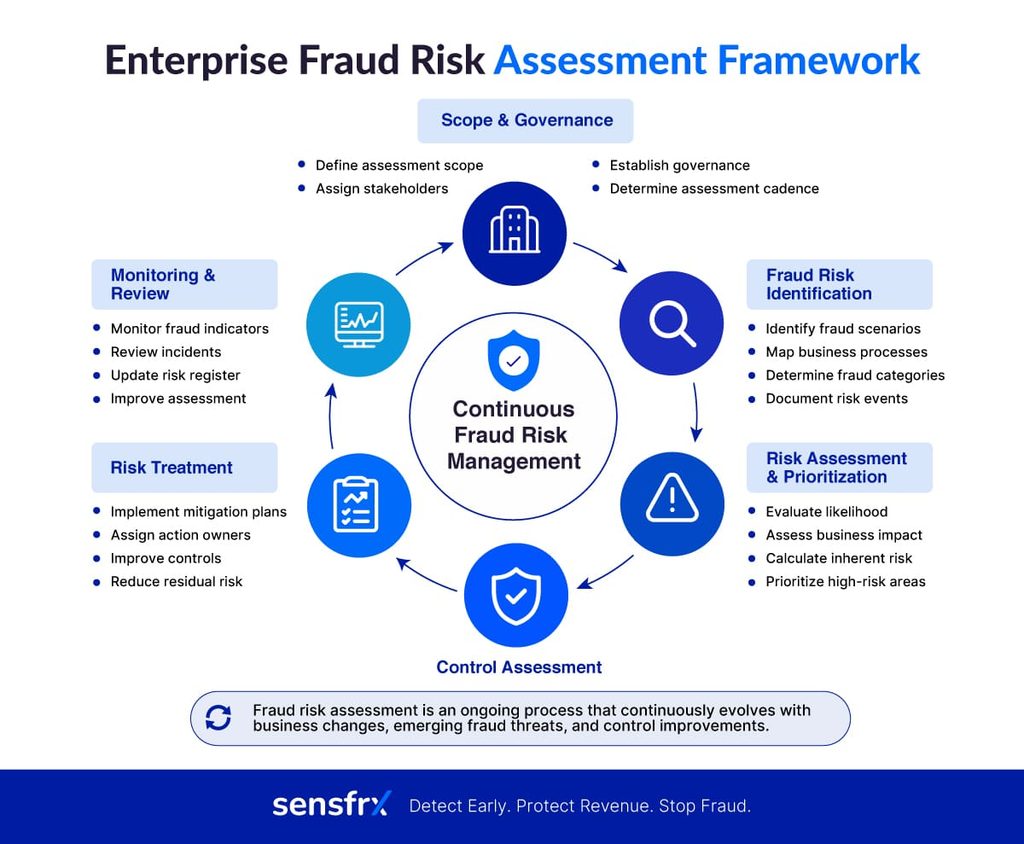
The 6-stage fraud risk assessment framework
Let us now take you through the 6- stage fraud risk assessment framework and understand what each step entails:
Step 1: Scope and governance
Before identifying a single risk, define:
| Question | What to decide |
| Scope | Which business units, subsidiaries, departments, business processes, third parties, or geographic locations are included in the assessment (e.g., procurement, payroll, finance, sales, HR, IT, supply chain). |
| Ownership | Who is responsible for leading the assessment (e.g., Enterprise Risk Management (ERM), Internal Audit, Compliance, Fraud Risk Management, or a cross-functional committee with Finance, Legal, HR, IT, and Operations). |
| Cadence | How often the assessment will be performed (e.g., annually or semi-annually) and the events that trigger reassessment, such as mergers and acquisitions, new business initiatives, significant organizational changes, fraud incidents, regulatory changes, or implementation of new systems. |
| Reporting Line | Who reviews and approves the assessment results (e.g., executive management, Risk Committee, Audit Committee, or Board of Directors), how findings are reported, and who has the authority to approve mitigation plans and control improvements. |
Step 2: Risk identification
List every plausible fraud scheme, not just the ones that have already happened. Group by category so nothing gets missed:
| Business Process | Common Fraud Risks |
| Procurement | Vendor fraud, kickbacks |
| Payroll | Ghost employees |
| Accounts Payable | Duplicate payments |
| Accounts Receivable | Payment diversion |
| Expense Management | Expense reimbursement fraud |
| Sales | Revenue manipulation |
| Inventory | Theft and inventory shrinkage |
| Third-party Management | Supplier collusion |
| IT | Identity misuse and privileged access abuse |
Most published frameworks stop at the first two rows. For an e-commerce or fintech business, the last two rows usually carry more financial exposure.
Step 3: Likelihood and impact scoring
Below is a likelihood and impact matrix to help you with impact scoring:
Score each risk on two 1-5 scales:
| Score | Likelihood | Impact |
| 1 | Rare, no history of this in the business | Negligible financial or reputational cost |
| 2 | Unlikely, isolated past incidents | Minor cost, easily absorbed |
| 3 | Possible, occurs occasionally in the industry | Moderate cost, noticeable in a quarterly report |
| 4 | Likely, has occurred more than once | Significant cost, affects margin or requires disclosure |
| 5 | Almost certain, ongoing or recurring | Severe, threatens processor relationships, licensing, or solvency |
Multiply likelihood x impact for a risk score out of 25. This gives you a ranked list.
Note: A 1–5 likelihood × impact model is a practical starting point, not a universal standard. Organizations should define scoring criteria and thresholds according to their risk appetite, business model, and regulatory requirements.
Step 4: Control mapping
For every risk scoring above a set threshold (say, 12 or higher), map existing controls against it:
| Risk | Existing Control | Control Type | Gap Identified |
| Procurement fraud (e.g., fictitious vendors, kickbacks) | Vendor onboarding and approval process | Preventive | No periodic vendor due diligence or conflict-of-interest reviews |
| Payroll fraud (e.g., ghost employees, unauthorized payroll changes) | HR approval workflow and payroll reconciliation | Detective | No segregation of duties or automated payroll exception monitoring |
| Expense reimbursement fraud | Manager approval for expense claims | Detective | No automated duplicate expense detection or receipt validation |
| Financial statement fraud | Management review and journal entry approvals | Preventive | No independent review of high-risk journal entries or unusual adjustments |
| Third-party/vendor fraud | Third-party due diligence during onboarding | Preventive | No ongoing monitoring of vendor risk or periodic compliance reviews |
| Asset misappropriation | Asset inventory records and periodic audits | Detective | Physical inventory counts performed infrequently and asset tracking is manual |
| Unauthorized system access | Role-based access control (RBAC) and password policy | Preventive | User access reviews are not conducted regularly; privileged accounts are not continuously monitored |
| Bribery and corruption | Code of conduct and ethics training | Preventive | Gifts, hospitality, and third-party payments are not centrally monitored or reviewed |
Step 5: Residual risk and control testing
Once controls are mapped, test whether they actually work, not just whether they exist on paper.
| Test question | Why it matters |
| Is the control operating as designed right now? | A rule that was configured correctly a year ago may have been quietly disabled or bypassed |
| Does the control catch the scheme at the volume fraud actually occurs at? | A manual review process that works at 10 cases a day breaks down at 500 |
| What’s the residual risk score after the control is applied? | This is the number that should drive investment decisions, not the inherent risk score |
STEP 6: Continuous monitoring and real-time scoring
It is the one that matters most for transaction fraud.
Key components to describe here:
| Component | Role |
| Event stream | Every login, checkout, or account change generates a scoreable event |
| Signal enrichment | Device fingerprint, IP reputation, behavioral pattern, and historical account data are attached to the event |
| Real-time scoring | A weighted or model-based score is generated in milliseconds |
| Action routing | Score thresholds route the event to auto-approve, step-up verification, manual review, or block |
| Feedback loop | Confirmed fraud and confirmed false positives are fed back to retrain the scoring logic |
This stage is where a periodic assessment turns into an operating system for fraud risk, rather than a document that gets filed away until next year’s audit.
Building a Fraud Risk Scoring Model
A scoring model turns the 1-5 likelihood/impact exercise into something that can run against live data. A simple weighted model looks like this:
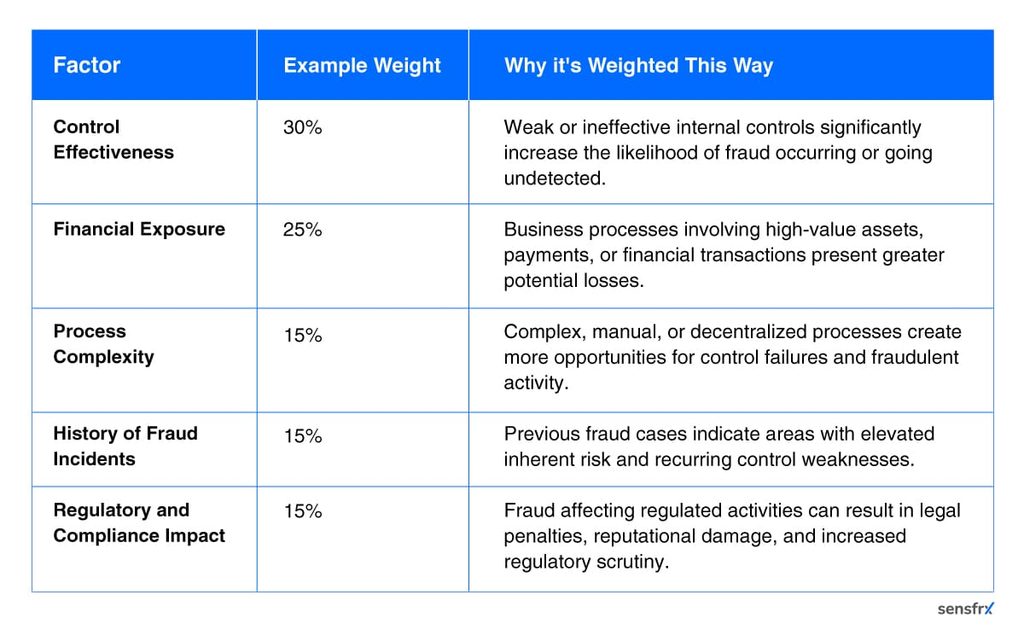
Static weighted models like this are a reasonable starting point. Machine-learning-based scoring extends the same idea by learning weights and interactions from historical labeled fraud data instead of setting them manually, and by updating as new fraud patterns appear. The framework stages don’t change. What changes is how stage 3 and stage 6 are executed.
Fraud Risk Assessment Template
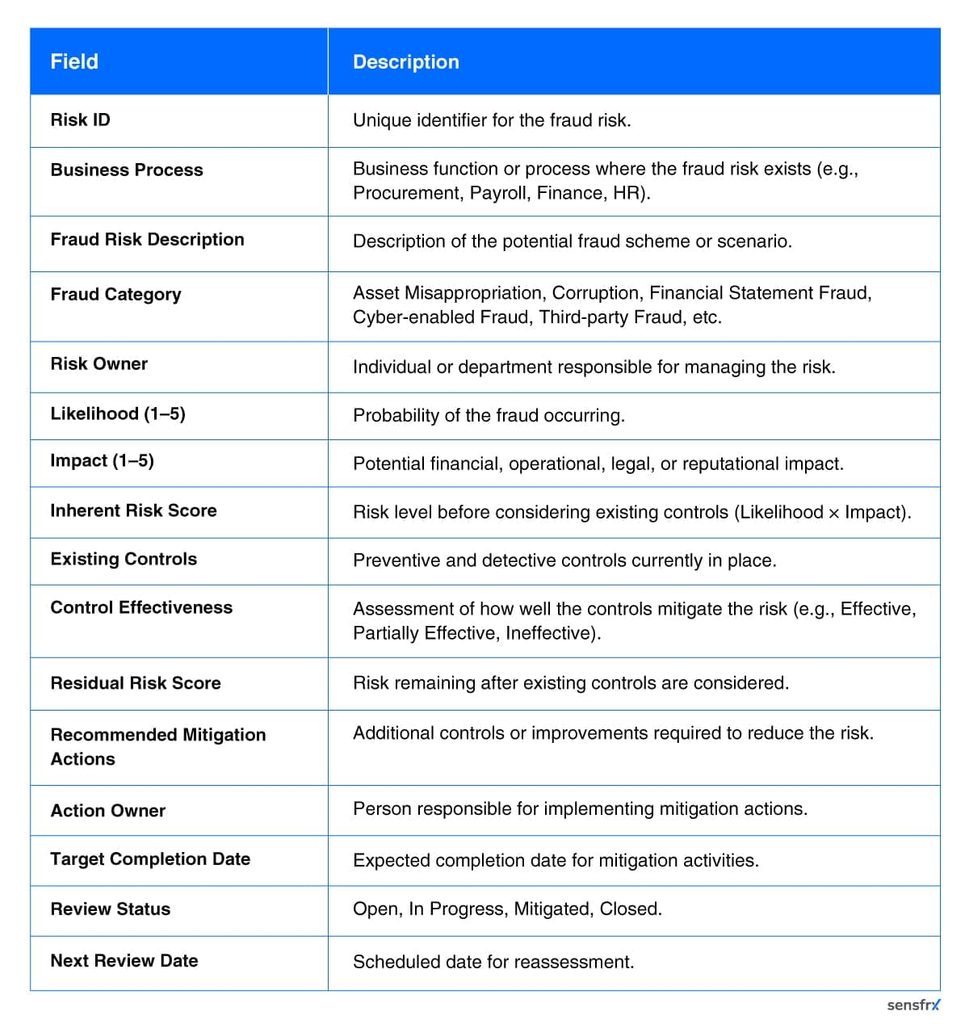
A copy-ready structure for a risk register:
The following template can be used to document, evaluate, and monitor fraud risks across business units and processes. It provides a consistent structure for assessing inherent and residual risks, mapping controls, and tracking mitigation efforts.
Example
| Risk ID | Business Process | Fraud Risk | Inherent Risk | Existing Controls | Residual Risk | Status |
| FR-001 | Procurement | Fictitious vendor creation resulting in fraudulent payments | 20 | Vendor approval workflow, segregation of duties | 10 | In Progress |
| FR-002 | Payroll | Ghost employee fraud | 16 | HR approval, payroll reconciliation | 8 | Mitigated |
| FR-003 | Expense Management | Duplicate or falsified expense reimbursements | 15 | Manager approval and expense policy | 9 | Open |
| FR-004 | Finance | Unauthorized journal entry manipulation | 20 | Journal approval workflow and audit logs | 12 | Open |
Recommend keeping this in a shared, versioned sheet so residual scores can be tracked quarter over quarter rather than starting fresh each cycle.
Worked Example: Enterprise Fraud Risk Assessment in Action
A manufacturing company with operations across three countries conducts its annual fraud risk assessment to evaluate risks across procurement, payroll, finance, and third-party vendor management. After assessing likelihood, impact, and existing controls, the team identifies three high-priority risks:
- Procurement fraud (Inherent Risk Score: 20) due to weak vendor due diligence and limited oversight of supplier onboarding.
- Payroll fraud (Inherent Risk Score: 16) because payroll changes rely on manual approvals with no independent review.
- Expense reimbursement fraud (Inherent Risk Score: 15) caused by inconsistent verification of employee expense claims.
The assessment shows that while approval workflows exist, they are largely manual and do not effectively detect fraudulent activity. To address these gaps, the organization introduces stronger vendor verification procedures, segregation of duties for payroll changes, automated duplicate expense checks, and quarterly control testing.
After implementing these improvements, the residual risk scores decrease to 10, 8, and 9, respectively. Procurement fraud remains a high-priority risk and is reviewed quarterly by the Risk Committee, while payroll and expense fraud are incorporated into routine control monitoring by Internal Audit.
This example shows how a structured fraud risk assessment helps organizations move beyond identifying risks to prioritizing remediation efforts, strengthening controls, and allocating resources to the areas with the greatest business impact.
Common Mistakes Organizations make
| Mistake | Consequence |
| Treating the assessment as an annual compliance exercise only | Misses fast-moving digital fraud that changes shape within weeks |
| No defined reassessment trigger | New product launches or market expansions go live without a fraud risk review |
| Focusing only on internal fraud categories | Transaction and account-level fraud, often the larger dollar exposure, goes unscored |
| No cross-functional input | Product and engineering teams aren’t involved, so control gaps in checkout or onboarding flows go unnoticed |
| No feedback loop from monitoring back to the risk register | Confirmed fraud patterns never update the likelihood or impact scores that drove the original assessment |
Turning Standards into Action
Regardless of which framework you refer to, every fraud risk assessment should answer the same practical questions:
- Are we assessing the fraud risks that matter most to the business?
- Do our existing controls effectively reduce those risks?
- Which high-risk areas require immediate mitigation?
- How will we monitor fraud risks as the business, technology, and threat landscape evolve?
- Who is accountable for reviewing, updating, and reporting fraud risks?
If your assessment can consistently answer these questions, you’re not simply complying with a standard; you’re building a repeatable fraud risk management program that supports better business decisions, stronger controls, and continuous improvement.
Conclusion
A fraud risk assessment framework only earns its keep when it changes what a business actually does, not just what it documents. Combining the governance rigor of COSO and ISO 31000 with a practical risk-scoring model and continuous monitoring gives fraud teams a framework they can use to identify, prioritize, and respond to risk as it evolves.
This is where a platform such as Sensfrx can help operationalize the framework. By combining device intelligence, behavioral signals, IP and email analysis, and real-time risk scoring, Sensfrx can help businesses turn the risks identified during an assessment into actionable controls at key points across the customer journey. The result is a fraud risk program that moves beyond periodic assessment to continuous detection, decision-making, and improvement.
Ready to turn your fraud risk assessment into action? Explore how Sensfrx can help you detect high-risk activity, make real-time risk decisions, and strengthen fraud controls across the customer journey.
Frequently Asked Questions (FAQs)
How often should a fraud risk assessment be done?
Most organizations run a full assessment annually, with trigger-based reassessment whenever a new product, payment method, or market is introduced. Continuous monitoring (stage 6) runs constantly in between formal assessment cycles.
What’s the difference between fraud risk assessment and fraud risk management?
Assessment is the process of identifying, scoring, and mapping controls against fraud risks. Management is the broader ongoing discipline that includes assessment plus governance, control design, monitoring, and response.
Do small businesses need a formal fraud risk assessment framework?
Yes, though the scope can be lighter. Even a simple risk register with the six stages above, run twice a year, gives a small business more visibility than an ad hoc approach.
What’s the difference between inherent risk and residual risk?
Inherent risk is how exposed the business is before any controls are applied. Residual risk is what remains after existing controls are factored in. Investment decisions should be based on residual risk, not inherent risk.
Can fraud risk scoring be automated?
Yes. Static weighted models can run as rules engines, and more mature setups use machine-learning-based scoring that updates as new fraud patterns are confirmed. Both plug into the same six-stage framework; only the mechanics of stage 3 and 6 change.