Address Verification System, or AVS, is a fraud check that compares the billing address a customer enters at checkout with the address the card-issuing bank has on file. When a shopper types in their street number and ZIP code, that data gets sent to the bank, which checks it against its own records and sends back a response code showing how closely the two match.
AVS doesn’t verify a person’s identity. It doesn’t confirm that a card hasn’t been stolen. It simply checks whether the address on the order matches the address tied to the card. That’s a narrow job, but it’s an important one, and it’s why AVS has been a standard part of card processing for decades.
Why Was AVS Created?
AVS was built for a specific problem: card-not-present fraud. When a customer swipes a card in a store, the merchant can check an ID or watch the transaction happen. Online and phone orders don’t have that safeguard. Card networks and issuing banks needed a way to add a layer of verification when the physical card and the cardholder aren’t in front of anyone.
The system dates back to the 1990s, when mail-order and telephone-order (MOTO) businesses needed a way to catch stolen card numbers before shipping expensive goods to an address that had nothing to do with the actual cardholder. As e-commerce grew, AVS became a default fraud tool baked into most payment gateways, often running quietly in the background of every transaction.
How Does Address Verification System (AVS) Work?
The Address Verification System (AVS) operates behind the scenes during payment authorization, comparing the billing address the customer entered with the billing address stored by the issuing bank. The result helps merchants assess whether a transaction warrants additional scrutiny before approval.
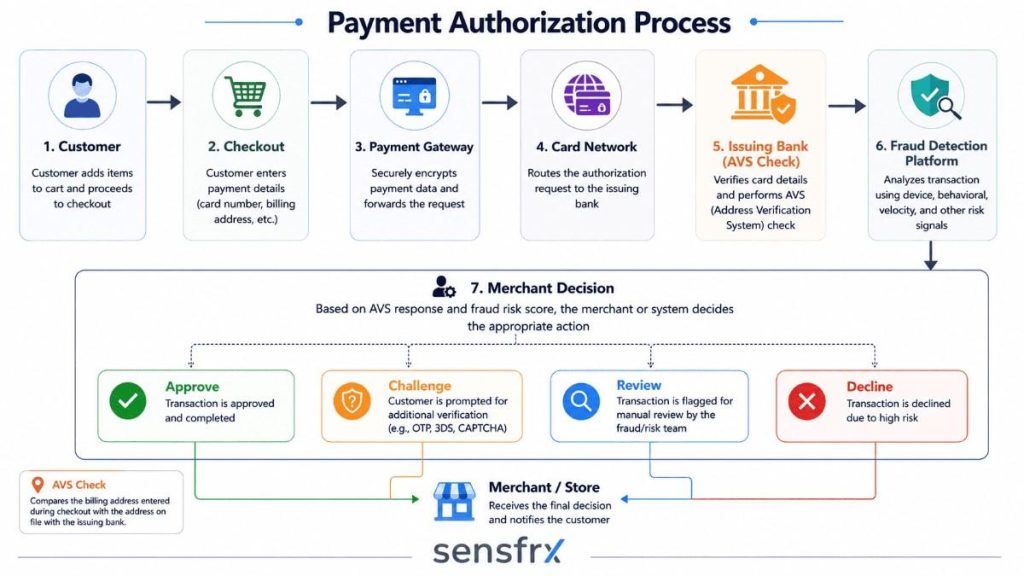
However, it’s important to understand that AVS is only one checkpoint in a much larger payment risk assessment process. Modern ecommerce businesses don’t approve or decline payments based solely on an AVS response; they combine it with other fraud signals to make more informed decisions.
Step 1: Customer Enters Payment Details
When a customer checks out, they provide:
- Card number
- Expiration date
- CVV
- Billing address
- Name (optional for AVS)
- Shipping address (if applicable)
At this stage, the merchant simply collects the information. No verification has occurred yet.
Step 2: The Payment Gateway Sends an Authorization Request
The payment gateway securely sends the transaction details to the acquiring bank, which forwards the request through the card network (Visa, Mastercard, American Express, etc.) to the issuing bank.
Among the details transmitted is the customer’s billing address, which the issuer will use for AVS verification.
Step 3: The Issuing Bank Performs the AVS Check
The issuing bank compares the billing address submitted during checkout with the address associated with the payment card in its records.
Rather than returning the customer’s actual address, the issuer responds with an AVS response code indicating whether:
- The street number matches
- The ZIP or postal code matches
- Both match
- Neither matches
- Address verification couldn’t be completed
This protects sensitive customer information while giving merchants enough context to assess transaction risk.
Step 4: The Merchant Receives the AVS Response
The payment gateway forwards the AVS response code to the merchant’s payment system or fraud prevention platform.
This is where many merchants make a common mistake.
An AVS mismatch doesn’t automatically mean the transaction is fraudulent, just as a full AVS match doesn’t guarantee it’s legitimate. Legitimate customers may mistype their address or recently move, while fraudsters may possess the correct billing address from a data breach.
Instead of making an immediate decision, merchants should evaluate the AVS result alongside additional fraud signals.
Step 5: The Fraud Engine Evaluates Multiple Risk Signals
Modern fraud prevention platforms treat AVS as one input among many. Before deciding whether to approve, challenge, review, or decline a payment, they evaluate additional indicators such as:
- Device fingerprint and reputation
- IP reputation and geolocation
- VPN or proxy usage
- Customer purchase history
- Transaction velocity
- Behavioral analytics
- Bot detection signals
- Email and phone intelligence
- Historical fraud patterns
- Machine learning risk score
This layered analysis provides far greater accuracy than relying on AVS alone.
Example: A transaction may receive a full AVS match but still be flagged as high risk if it originates from a new device, uses a residential proxy, exhibits bot-like behavior, and attempts multiple high-value purchases within minutes.
Understanding AVS Response Codes and Merchant Actions
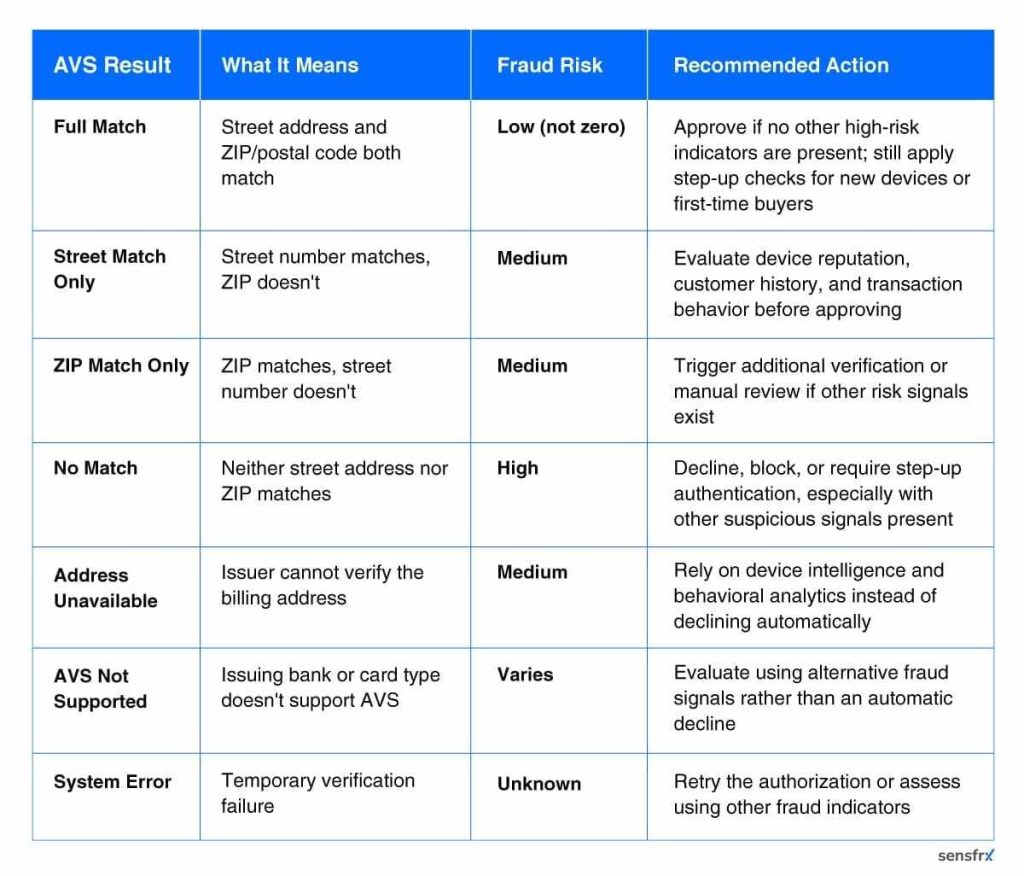
When an AVS check is complete, the issuing bank returns a response code, not a simple pass or fail.
The table below combines what each code means with the recommended merchant response, factoring in supporting risk context like device reputation and customer history.
What Each Party Sees During an AVS Check
Understanding how different participants view the transaction helps explain why AVS is only one piece of the fraud detection puzzle.
| Participant | What They See | Purpose |
| Customer | Checkout form requesting billing address | Completes the purchase. |
| Merchant | AVS response code and fraud score | Decides whether to approve, review, challenge, or decline the transaction. |
| Payment Gateway | Authorization request and issuer response | Securely routes payment information. |
| Issuing Bank | Customer’s stored billing address and submitted address | Determines whether the addresses match and returns an AVS response code. |
| Fraud Prevention Platform | AVS result plus hundreds of additional risk signals | Calculates an overall fraud risk score using contextual analysis. |
Limitations of AVS
While AVS is effective at identifying billing address inconsistencies, it cannot detect account takeover, card testing, friendly fraud, or transactions where fraudsters possess accurate billing information. Understanding these limitations is essential to building a fraud strategy that can address today’s evolving threats.
AVS Match Doesn’t Always Mean a Safe Transaction
A full AVS match simply means the billing address on file lines up with what was entered. It says nothing about who actually placed the order.
A few ways a fraudster can pass AVS cleanly:
- Stolen billing details. If a criminal has full access to someone’s card and billing address (through a data breach, phishing, or physical theft of mail), they can enter accurate information and sail through AVS.
- Card testing bots. Automated scripts sometimes test stolen card numbers against real billing addresses pulled from breached data sets, generating full matches on fraudulent orders.
- Account takeover. When a fraudster gains access to an existing customer account, the saved billing address is already correct, so AVS won’t raise a flag even though the order itself is fraudulent.
- Friendly fraud. A cardholder who makes a legitimate purchase and later disputes it as unauthorized will have passed AVS perfectly, since it was their own address and card all along.
Note: This is the core limitation fraud teams need to internalize: AVS is a data match, not an identity check.
Legitimate Customers Also Fail AVS
The flip side is just as important. Real customers fail AVS regularly, for reasons that have nothing to do with fraud.
- Recent move. The customer updated their shipping address, but their bank still has the old billing address on file.
- Gift purchases. Someone buying a gift enters the recipient’s shipping address while their billing address stays tied to their own home.
- International cards. Address formats differ by country, and many international issuers don’t support AVS at all, resulting in an automatic mismatch or “unavailable” response.
- Typos. A simple mistyped apartment number or ZIP code digit can trigger a mismatch on an otherwise legitimate order.
- PO boxes and business addresses. Some issuers store a different format than what the customer enters, especially for corporate cards or PO box billing.
This is why relying on AVS alone, especially as a hard block, tends to reject good customers along with the bad ones.
AVS alone isn’t enough
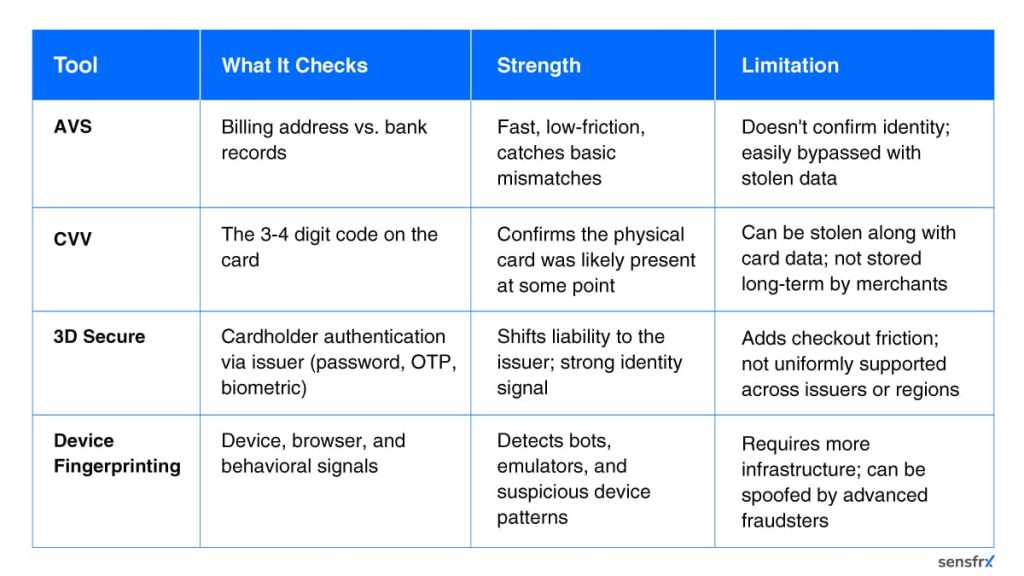
AVS is one piece of a larger fraud detection toolkit. No single tool works well in isolation.
Fraud teams that rely on one check tend to see either high fraud losses or high false declines. The strongest setups combine several signals, so no single weak point decides the outcome.
Here’s how it stacks up against the other checks merchants commonly layer alongside it:
Real-World Ecommerce Fraud Scenarios
Scenario 1: The card testing wave. A fraud ring runs hundreds of small transactions through a checkout page using stolen card numbers paired with billing addresses pulled from a breached database. AVS shows full matches across the board because the underlying data is accurate. It’s only the transaction velocity and device patterns that expose the attack.
Scenario 2: The gift order flag. A regular customer orders a birthday gift and ships it to a friend’s address in another city. AVS flags a partial mismatch since the shipping and billing addresses differ. Without additional context, the order gets declined and a loyal customer is turned away.
Scenario 3: Account takeover. A fraudster gains access to a customer’s saved account, changes the shipping address, and places a large order using the saved card and billing address. AVS passes cleanly because the billing details were never touched, but the shipping change and unusual order size should have triggered a closer look.
Industries That Benefit Most from AVS
Below is a list of industries that AVS most benefits
1. E-commerce Retail: E-commerce businesses process a high volume of card-not-present transactions, making them a common target for payment fraud. AVS helps verify the cardholder’s billing address, reducing the risk of fraudulent purchases, especially for gift orders and drop-shipping transactions.
2. Subscription and SaaS: Subscription-based businesses rely on recurring billing. Verifying the billing address during the initial payment helps detect stolen credit cards early, preventing future fraudulent recurring charges and chargebacks.
3. Digital Goods and Gift Cards: Digital products and gift cards are delivered instantly and have a high resale value, making them attractive targets for fraudsters. AVS adds an extra layer of verification before these transactions are approved, helping merchants reduce fraud losses.
4. Travel and Ticketing: Travel bookings and ticket purchases often involve high-value transactions, where chargebacks can result in significant financial losses. AVS helps verify customer identity and reduces the likelihood of fraudulent bookings.
5. Electronics and Luxury Retail: Fraudsters frequently target high-value products such as electronics, jewellery, and luxury goods because they can be easily resold. AVS helps merchants identify suspicious transactions and minimise losses from stolen card fraud.
Best Practices for AVS Integration
Merchants should configure and use AVS intelligently, not as a standalone rule.
- Never rely on AVS as a standalone accept or decline rule. Combine it with CVV, 3D Secure, and behavioral signals before making a final decision.
- Log the full AVS response code, not just a pass or fail flag. Partial matches carry different risk levels and are worth preserving for analysis.
- Build region-aware logic. International cards and certain countries don’t support AVS consistently, so treat “unavailable” differently from “no match.”
- Route ambiguous cases to manual review instead of auto-declining. A partial match paired with a clean device and order history often doesn’t warrant an automatic rejection.
- Test against sandbox response codes from your payment processor. Different processors format AVS codes differently, so confirm mapping before going live.
- Monitor false decline rates alongside fraud rates. A drop in fraud that comes with a spike in abandoned legitimate orders isn’t a win.
Merchant KPIs to Monitor
To leverage the full potential of AVS, it is important to monitor the below-mentioned KPIs regularly and take the intended actions.
1. AVS Match Rate
Why It Matters: Measures how often customers enter billing addresses that match the card issuer’s records.
What Merchants Should Do: If the match rate suddenly drops, investigate checkout issues, address formatting changes, or a potential increase in fraudulent transactions.
2. False Decline Rate
Why It Matters: Tracks how many legitimate customers are rejected because of AVS or other fraud rules.
What Merchants Should Do: If false declines increase, review your AVS rules, reduce reliance on hard declines, and incorporate additional fraud signals before rejecting transactions.
3. Chargeback Rate
Why It Matters: Indicates how effectively your fraud controls prevent unauthorized transactions.
What Merchants Should Do: If chargebacks rise despite high AVS match rates, strengthen your fraud strategy with device intelligence, behavioural analytics, and account monitoring instead of relying on AVS alone.
4. Manual Review Volume
Why It Matters: Shows how many transactions require human investigation.
What Merchants Should Do: A consistently high review volume may indicate overly conservative fraud rules. Fine-tune your risk thresholds to automate more low-risk approvals without increasing fraud.
5. Approval Rate by Region
Why It Matters: Reveals whether customers from specific countries are being declined more frequently due to AVS limitations or address formatting differences.
What Merchants Should Do: If approval rates are significantly lower in certain regions, implement region-specific AVS rules and rely more on alternative fraud signals where AVS support is limited.
Monitoring these KPIs helps merchants determine whether their AVS strategy is effectively balancing fraud prevention with customer experience. The objective isn’t to maximize AVS matches or decline more transactions; rather, it’s to reduce fraud while minimizing false declines and maintaining healthy approval rates.
Common AVS Mistakes That Increase Fraud
Even when merchants enable AVS, the way they configure and use it can significantly impact fraud prevention outcomes. Overreliance on AVS or poorly designed rules can lead to higher fraud losses, increased false declines, and unnecessary friction for legitimate customers. Avoid these common mistakes to get the most value from AVS.
- Treating AVS as a complete fraud solution instead of one input among many
- Auto-declining every partial mismatch without considering other signals
- Ignoring regional differences in AVS support and address formatting
- Failing to update AVS rules as fraud patterns shift over time
- Not distinguishing between billing and shipping address mismatches, which have very different risk implications
Building a Layered Fraud Prevention Strategy
No single fraud prevention tool can stop every attack. The strongest ecommerce security strategies combine AVS with multiple verification and risk assessment technologies, allowing each layer to compensate for the limitations of the others.
A typical layered approach includes:
- Data validation at checkout: Use AVS and CVV checks to verify billing details and identify basic payment inconsistencies.
- Identity verification: Add 3D Secure to authenticate the cardholder and reduce unauthorized transactions.
- Device and behavioral intelligence: Analyze device fingerprints, browsing behavior, and bot signals to detect suspicious activity that AVS cannot identify.
- Velocity and transaction monitoring: Track purchase frequency, order values, and customer history to uncover unusual patterns that may indicate fraud.
- AI-powered risk scoring: Combine all fraud signals into a real-time risk score that adapts to evolving fraud tactics and supports more accurate payment decisions.
By layering AVS with authentication, device intelligence, behavioral analytics, and AI-driven risk scoring, merchants can detect sophisticated fraud while minimizing false declines and maintaining a seamless checkout experience.
Merchant Security Checklist
Implementing AVS is only the first step toward reducing payment fraud. To maximize its effectiveness, merchants should regularly review their AVS configuration, combine it with complementary fraud controls, and continuously monitor performance. Use the following checklist to ensure your AVS strategy supports both fraud prevention and a smooth customer experience.
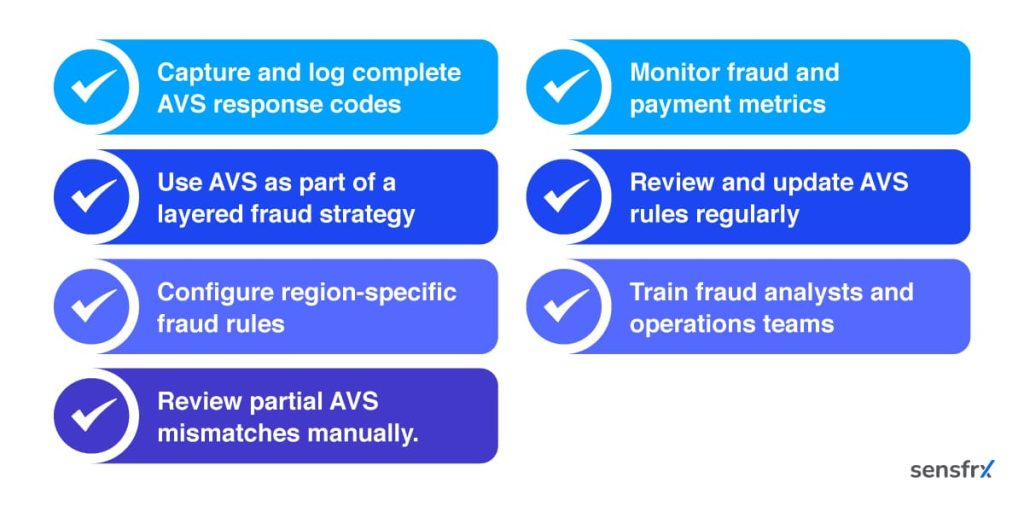
AVS Implementation Checklist
- Capture and log complete AVS response codes: Ensure your payment gateway stores the full AVS response code—not just a pass or fail result—so fraud teams can make more informed decisions and analyze historical trends.
- Use AVS as part of a layered fraud strategy: Combine AVS with CVV verification, 3D Secure, device intelligence, behavioral analytics, and AI-powered risk scoring instead of relying on a single fraud check.
- Configure region-specific fraud rules: Adjust AVS policies for countries where support is limited or address formats differ, to reduce unnecessary false declines.
- Review partial AVS mismatches instead of automatic decline: Evaluate additional risk signals, such as device reputation, customer history, transaction velocity, and order behavior, before making a final decision.
Conclusion
Address Verification System (AVS) is a valuable first layer of defense against card-not-present fraud, but it isn’t designed to stop modern fraud on its own. The most effective fraud prevention strategies combine AVS with device intelligence, behavioral analytics, bot detection, and AI-driven risk scoring to make smarter payment decisions while reducing false declines.
Looking to strengthen your fraud prevention strategy? Sensfrx combines AVS with real-time risk signals, device fingerprinting, and AI-powered fraud detection to help merchants reduce chargebacks, stop sophisticated attacks, and approve more legitimate transactions. Request a demo to see how Sensfrx can protect your business.
Frequently Asked Questions (FAQs)
Does AVS work for international transactions?
Not consistently. Many countries outside the US and Canada use different address formats or don’t participate in AVS at all, so international transactions often return an “unavailable” response rather than a true match or mismatch.
Can a transaction be declined solely because of an AVS mismatch?
It can be, if a merchant sets up rules that way, but it’s generally not recommended. A mismatch alone doesn’t confirm fraud, and blocking on AVS alone tends to reject a meaningful number of legitimate customers.
Is AVS required by card networks?
AVS isn’t universally mandated, but most processors support it, and many merchants use it as a standard part of their fraud checks, particularly in the US.
Does AVS protect against chargebacks?
It helps reduce certain types of chargebacks tied to stolen card fraud, but it doesn’t protect against friendly fraud or account takeover, where the billing details are accurate but the transaction is still disputed later.
How is AVS different from a Know Your Customer (KYC) check?
AVS checks a data match between an entered address and bank records. KYC verifies a customer’s actual identity, often through government ID or other documentation. They serve different purposes and aren’t interchangeable.