For nearly a decade, Two-Factor Authentication (2FA) has been recommended as essential protection for online accounts. Security experts, technology companies, and financial institutions have all championed SMS-based One-Time Passwords (OTPs) as a reliable defence against unauthorised access. The logic seemed sound: even if hackers obtained your password, they would still need access to your phone to receive the verification code.
However, cybercriminals have evolved their tactics. A sophisticated threat has emerged that exploits the weakest link in digital security: human psychology. OTP bots now allow attackers to bypass SMS authentication in real-time, transforming what was once considered robust protection into a vulnerable access point.
This article examines how OTP bots operate, why they have become alarmingly accessible to criminals worldwide, and what individuals and organisations must do to protect themselves in this new threat landscape.
What Are OTP Bots?
An OTP bot is an automated tool or service designed to intercept, solicit, or steal one-time passwords used in multi-factor authentication systems. Unlike traditional hacking methods that attempt to guess or crack passwords through brute force, OTP bots employ a more insidious approach: they manipulate users into voluntarily surrendering their authentication codes.
These bots operate at the intersection of technology and social engineering. They automate the process of contacting victims, impersonating legitimate organisations, and extracting verification codes, all within the brief window before those codes expire (typically 30 to 60 seconds).
The ultimate goal is Account Takeover (ATO). By obtaining both login credentials and the corresponding OTP, attackers gain complete access to accounts, even those protected by what users believed was strong security.
The Anatomy of an OTP Bot Attack
Understanding how these attacks unfold reveals why they are so effective:
Step 1: Credential Acquisition

The attack begins long before the victim receives any suspicious communication. Hackers obtain usernames and passwords through various means: purchasing them from dark web marketplaces, exploiting previous data breaches, or conducting phishing campaigns. With billions of credentials circulating from past breaches, finding valid login information has become disturbingly easy.
Step 2: The Login Trigger
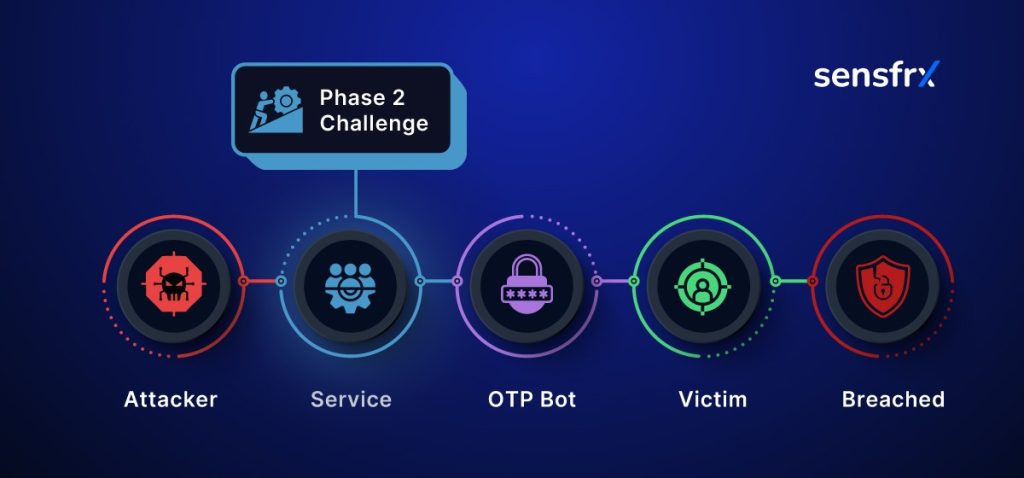
Once armed with credentials, the attacker (or their automated system) attempts to log into the victim’s account. This action triggers the legitimate service to send a real OTP to the victim’s registered phone number. This is a genuine code from the actual company, making it harder for victims to recognise the scam.
Step 3: The Social Engineering Strike
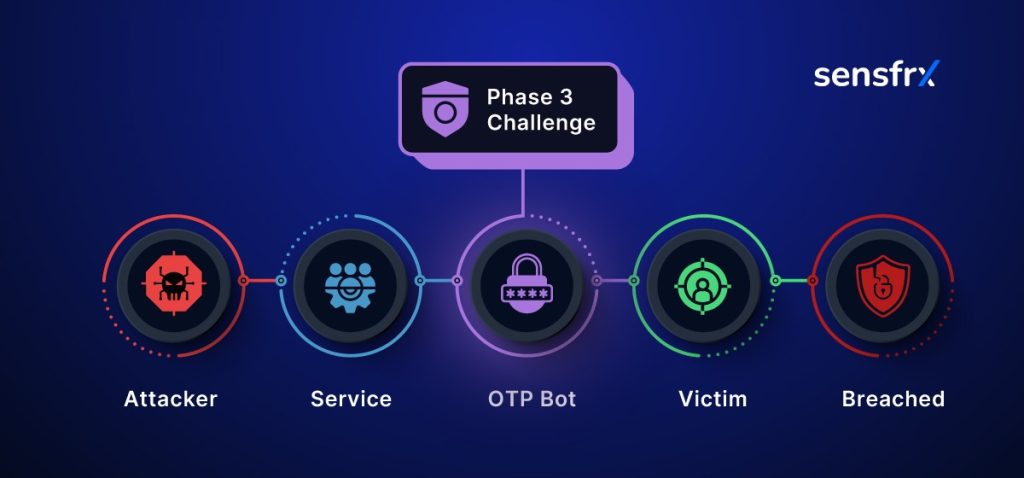
Within seconds of the OTP being sent, the bot springs into action. The victim receives a phone call or text message that appears to come from a trusted source. Sophisticated caller ID spoofing makes the communication appear legitimate, displaying the name of a bank, technology company, or government agency.
The bot’s script is carefully crafted: “We have detected suspicious activity on your account. To verify your identity and prevent unauthorized access, please provide the security code we just sent to your phone.” The urgency and apparent legitimacy of this request catch victims off guard.
Step 4: Code Relay and Entry
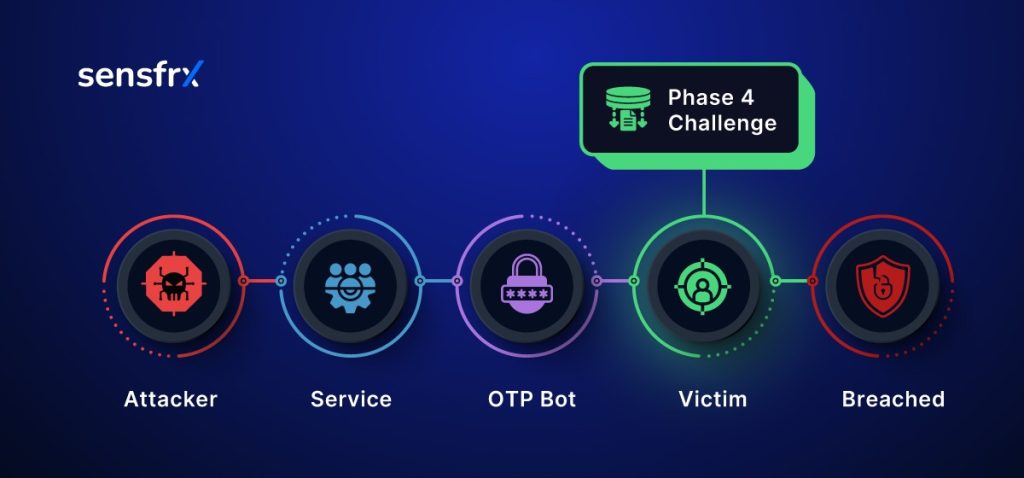
When the victim provides the code (either by speaking it during a call or entering it into a fake website), the bot instantly captures and relays this information to the attacker. Speed is critical, as most OTPs expire within 60 seconds.
Step 5: Access Granted
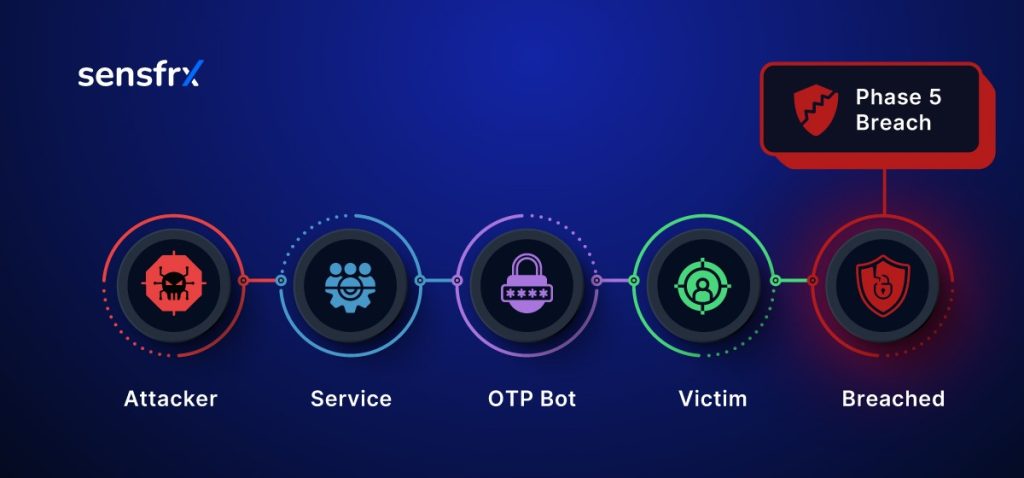
The hacker enters the freshly intercepted code into the real login page before it expires. The authentication system, having received valid credentials and a valid OTP, grants access. The attacker now controls the account and can change passwords, transfer funds, steal data, or conduct further attacks.
Why OTP Bot Threats Are Escalating
Several factors have converged to make OTP bot attacks more prevalent and dangerous:
The Bot-as-a-Service Economy
OTP bots are no longer exclusive tools of sophisticated hacking groups. They are now available as commercial services on underground marketplaces, particularly on Telegram channels and dark web forums. These Bot-as-a-Service operations rent access to OTP interception tools for as little as $10 to $100 per week.
This low barrier to entry means that individuals with minimal technical skills can launch sophisticated authentication bypass attacks. The democratisation of cybercrime tools has created an explosion in the volume of attacks worldwide.
Artificial Intelligence Integration
Modern OTP bots have incorporated Generative AI capabilities that make them significantly more effective:
- Conversational AI: Bots can now conduct natural-sounding phone conversations, adapting their responses based on victim reactions. They can handle questions, express appropriate urgency, and sound convincingly human.
- Voice Cloning: Deepfake technology allows bots to replicate the voices of customer service representatives or even people known to the victim, increasing trust and compliance.
- Script Optimisation: AI analyses successful attack patterns and continuously refines social engineering scripts to maximise effectiveness across different demographics and regions.
Next-Generation “Gen4” Bots
The latest generation of bots has evolved beyond simple automation. Gen4 bots employ:
- Behavioural Mimicry: These bots simulate human mouse movements, scrolling patterns, and typing rhythms to evade bot detection systems that analyse user behaviour.
- Adaptive Timing: They introduce realistic delays and variations in their actions to avoid triggering rate-limiting or anomaly detection systems.
- Multi-Channel Coordination: Advanced bots coordinate attacks across multiple communication channels simultaneously, using whichever method the victim is most likely to respond to.
The Scale of the Problem: Hard Data
Before diving into the mechanics, it is vital to understand the magnitude of this threat. This is not a theoretical risk; it is a measurable crisis.
- 50% of Incidents Involve MFA Bypass: According to 2024 data from Cisco Talos, nearly 50% of incident response engagements involved attackers attempting to bypass Multi-Factor Authentication (MFA). For a deeper understanding of how MFA works and its security implications, explore our guide on Multi-Factor Authentication.
- $10 Million from a Single Bot: The JokerOTP operation, dismantled in early 2025, facilitated over 28,000 successful attacks across 13 countries. This resulted in estimated theft of over $10 million.
- The SMS Pumping Crisis: Beyond theft, the SMS pumping fraud enabled by these bots cost businesses billions globally between 2022 and 2024. Some platforms reported SMS costs spiking by 300% due to artificial traffic.
The Threat Model: Why They Succeed
To defend against OTP bots, we must first define the architectural flaw they exploit. Most current MFA implementations rely on a Shared Secret model.
- Shared Secrets: The server generates a code (the secret) and sends it to you. Both you and the server know this code.
- Human Relay: The system relies on a human to bridge the gap by reading the code and typing it.
- Real-Time Phishing: If a bot can trick the human into relaying that code during the valid window (usually 60 seconds), the system cannot distinguish between the legitimate user and the attacker.
OTP bots do not hack the encryption. Instead, they exploit the trust assumption that anyone possessing the code is the owner of the phone.
Types of OTP Bot Attack Methods
OTP bots employ various techniques, each exploiting different vulnerabilities:
Voice-Based Social Engineering Bots
This remains the most common attack method. The bot places an automated phone call to the victim, using pre-recorded or AI-generated speech to impersonate a legitimate organisation. The script typically creates urgency (account security threat, payment verification, service cancellation) to pressure the victim into quickly providing the OTP.
MFA Fatigue Attacks
Rather than requesting a code directly, some bots exploit push notification-based authentication. They repeatedly trigger authentication requests, sending dozens or hundreds of push notifications to the victim’s device. Eventually, worn down by the constant interruptions, the victim may approve a request just to stop the notifications. This attack has successfully compromised accounts at major technology companies.
SMS Interception Through Network Vulnerabilities
More technically sophisticated attacks exploit weaknesses in mobile telecommunications infrastructure. The SS7 (Signalling System No. 7) protocol, used by cellular networks worldwide to route calls and messages, contains security flaws that allow attackers to intercept SMS messages remotely. This method bypasses the victim entirely, as they never know their OTP has been captured.
SIM Swapping Facilitation
OTP bots can coordinate with SIM swapping attacks, where criminals convince mobile carriers to transfer a victim’s phone number to a SIM card controlled by the attacker. Once the swap is complete, all SMS messages, including OTPs, are delivered directly to the hacker. Some bot services include social engineering scripts specifically designed to help attackers manipulate carrier customer service representatives.
The Real-World Impact
The consequences of OTP bot attacks extend beyond individual account compromises:
Direct Fraud Losses
In early 2025, cybersecurity researchers uncovered the “JokerOTP” operation, a coordinated campaign using OTP bots that resulted in approximately $10 million in theft across multiple countries. The attackers targeted banking customers, cryptocurrency exchange users, and e-commerce accounts.
SMS Pumping Fraud
Attackers have discovered they can weaponise OTP systems against the companies operating them. By triggering massive volumes of OTP requests, attackers generate enormous SMS traffic that companies must pay for. This “SMS pumping” fraud has cost some organisations millions annually. Social media platforms and authentication providers have been particularly hard hit, with some reporting SMS costs exceeding $60 million per year due to fraudulent OTP requests.
Infrastructure and Operational Strain
Beyond direct financial theft, OTP bot traffic creates significant operational challenges:
- Server Load: Floods of authentication requests consume computational resources, potentially degrading service for legitimate users.
- Customer Support Burden: Victims who realise they have been attacked require assistance, creating spikes in support ticket volumes.
- Reputational Damage: When customers’ accounts are compromised despite having 2FA enabled, trust in the platform erodes.
Case Study: The JokerOTP Operation
While many attacks are anonymous, the JokerOTP case provides a clear window into the industrialisation of this threat.
- The Setup: JokerOTP operated as a “Bot-as-a-Service” on Telegram. For a weekly subscription of roughly $100, criminals with zero coding skills could rent the bot.
- The Method: The bot included pre-written scripts for dozens of services, such as Amazon, PayPal, Coinbase, and major banks. Attackers simply input the victim’s phone number and the service name.
- The Failure: The targeted banks’ security systems failed because they treated the OTP as the final source of truth. They did not correlate the login attempt’s geolocation (often overseas) with the user’s typical behaviour, nor did they flag the speed of the entry.
- The Impact: Before its disruption in 2025, the ring compromised thousands of accounts. Victims lost life savings because they believed they were helping their bank stop fraud, when in reality, they were authorising it.
For SOC Teams: Enterprise Detection Signals
Prevention is ideal, but detection is mandatory. Security Operations Centres (SOCs) should monitor for these specific indicators of OTP bot activity:
- High OTP-to-Login Failure Ratio: A spike in OTPs generated without successful logins. This indicates the user is ignoring the bot or the code is expiring.
- The “Burst and Success” Pattern: A tight cluster of failed login attempts followed immediately by a successful login and a password change or email update.
- Telemetry Mismatches: Valid OTP entry coupled with “impossible travel”. For example, a login from Nigeria for a user who logged in from London an hour ago.
- SMS Cost Spikes: A sudden, unexplained rise in your SMS provider bill is often the first indicator of “SMS pumping” fraud.
- MFA Fatigue Signals: Multiple push notifications rejected by the user in a short window, followed by an acceptance. This usually indicates the user gave up and accepted the prompt.
How to Defend Against OTP Bots
Protecting against OTP bot attacks requires a multi-layered approach:
Move Beyond SMS-Based Authentication
Security experts increasingly view SMS as the weakest form of multi-factor authentication. Organisations and individuals should transition to more secure alternatives:
- Authenticator Apps: Time-based One-Time Password (TOTP) applications like Google Authenticator, Microsoft Authenticator, or Authy generate codes locally on your device. Because these codes are never transmitted over networks, they cannot be intercepted through SS7 exploits or social engineering calls.
- Hardware Security Keys: Physical devices like YubiKey or Titan Security Keys provide the strongest protection. They use cryptographic challenges that cannot be phished or replayed by bots.
- Passkeys: The newest standard in authentication, passkeys use public-key cryptography and biometric verification. They are inherently resistant to phishing, as they only work on legitimate websites and cannot be tricked into working on fake sites.
Implement Behavioural Analytics
Advanced security systems analyse user behaviour to detect anomalies before authentication even occurs:
- Device Fingerprinting: Tracking the characteristics of devices attempting to access accounts can flag unfamiliar hardware.
- Impossible Travel Detection: If an account is accessed from two geographically distant locations within an impossibly short timeframe, the system can block the second attempt.
- Behavioural Biometrics: Analysing how users type, move their mouse, or navigate interfaces can distinguish between legitimate users and bots mimicking human behaviour.
Deploy Technical Countermeasures
Several technical strategies can reduce vulnerability to OTP bot attacks:
- CAPTCHA Challenges: Requiring human verification before sending an OTP prevents automated systems from triggering unlimited authentication attempts.
- Rate Limiting: Restricting the number of OTP requests from a single account or IP address within a given timeframe prevents both SMS pumping fraud and rapid-fire attack attempts.
- Shortened Code Validity: Reducing OTP lifespan from 60 seconds to 30 seconds gives attackers less time to relay intercepted codes.
- Out-of-Band Verification: For high-risk transactions, requiring verification through a completely separate channel (such as email confirmation for a phone-based login) adds an additional hurdle for attackers.
Education and Awareness
Technology alone cannot solve the OTP bot problem. Users need to understand:
- Legitimate organisations never call requesting OTPs. Authentication codes should only be entered on websites or apps you accessed directly, never in response to unsolicited communications.
- Be suspicious of urgency. Social engineering relies on creating panic. Take time to verify the legitimacy of any unexpected security-related communication.
- Verify through official channels. If you receive a suspicious call claiming to be from your bank, hang up and call the official customer service number from the bank’s website.
The Path Forward
OTP bots represent a fundamental evolution in cybercrime: the industrialisation and democratisation of sophisticated attack techniques. What once required specialised knowledge and custom tools can now be executed by virtually anyone willing to spend a small amount of money on underground marketplaces.
For individuals, the message is clear: SMS-based two-factor authentication, whilst better than passwords alone, should no longer be considered adequate protection for important accounts. Whenever possible, enable app-based authentication, hardware keys, or passkeys.
For organisations, the challenge is more complex. The transition away from SMS authentication must be balanced against user convenience and accessibility. However, the evidence is mounting that SMS-based OTPs create a false sense of security whilst leaving both users and platforms vulnerable to automated attacks that can operate at massive scale.
The future of authentication lies in methods that are inherently resistant to social engineering and network interception. Passkeys, biometric authentication, and hardware tokens all share a critical characteristic: they cannot be verbally shared, typed into fake websites, or intercepted in transit. As OTP bots continue to evolve and become more accessible, the security community must accelerate the adoption of these phishing-resistant technologies.
The era of SMS as a reliable authentication method is ending. Organisations and individuals who adapt to this reality will be far better positioned to protect themselves in an increasingly hostile digital landscape.
Conclusion
The era of SMS as a reliable authentication method is ending. As attackers embrace AI and Bot-as-a-Service models, organizations must adapt by implementing behavioral analytics and phasing out interceptable secrets.
Protect Your Business from Automated Threats Don’t wait for an Account Takeover (ATO) crisis to modernize your security. Book a Demo with Sensfrx today to see how our AI-driven bot detection can identify and block OTP bots in real-time before they compromise your users.
Frequently Asked Questions (FAQs)
If I have 2FA enabled, am I still at risk?
Yes. If your 2FA is SMS-based, an OTP bot can trick you into revealing the code. The strongest protection is moving to a phishing-resistant method like a hardware key or Passkey.
How do I know if the caller is a bot or a real person?
Assume any unsolicited call asking for a code is a bot. Legitimate companies will never call you to ask for an OTP. If in doubt, hang up and call the official number on the company’s website.
Can bot detection software stop these attacks?
Advanced solutions that use behavioral biometrics and device fingerprinting can identify the “impossible travel” or non-human patterns of a bot relaying a code. Standard CAPTCHAs are often insufficient against Gen4 bots.
What is “SMS Pumping” fraud?
It’s when attackers use bots to trigger massive volumes of OTP requests to premium-rate numbers, leaving the business with a massive SMS bill.