
Digital wallets like Apple Pay, Google Pay, PayPal, Amazon Pay, and PhonePe have made online payments faster and more convenient. In fact, they accounted for nearly 50% of global eCommerce payment transactions in 2025, making them the most widely used online payment method.
While digital wallets offer strong security features, they are not immune to fraud. Criminals can exploit stolen credentials, compromised accounts, fake identities, or stolen payment cards to make unauthorized purchases. That’s why businesses need more than payment authentication—they need real-time fraud detection to identify suspicious activity and prevent fraud before it leads to chargebacks and revenue loss.
In this guide, you’ll learn what digital wallet fraud is, how fraudsters exploit digital wallet payments, and how it impacts your eCommerce business. You’ll also discover practical strategies and fraud prevention tools to detect suspicious activity and reduce fraud without adding friction to legitimate customers.
What is Digital Wallet Fraud?
Digital wallet fraud happens when criminals use stolen, compromised, or fake digital wallet accounts to make unauthorized purchases or transactions.
It usually comes down to one of a few things going wrong. A fraudster might gain access to a customer’s existing wallet through phishing or credential theft, then use the saved payment method as if they were the real owner. In other cases, they load stolen card details into a wallet they control, letting them spend without ever touching the physical card.
Sometimes it’s a full account takeover, where the attacker seizes control of an existing wallet and locks the real customer out entirely. And occasionally there’s no real customer at all: the wallet is created from scratch using synthetic or stolen identity details, built purely to commit fraud.
Whichever route they take, the outcome is the same. The fraudster gets past the “card present” and “verified user” checks merchants normally rely on, just by a different door.
Why Is Digital Wallet Fraud Growing?
Digital wallet fraud is increasing as more consumers choose digital wallets for their speed and convenience. While faster checkouts improve the shopping experience, they also give fraudsters fewer opportunities to be detected during the payment process.
Some of the key reasons behind the rise in digital wallet fraud include:
- Rapid adoption of digital wallets: More users mean more accounts for attackers to target.
- Faster checkout: Quick payments often involve fewer manual verification steps.
- Stolen credentials: Login details leaked in data breaches are sold and reused by fraudsters.
- Growth of mobile commerce: More mobile shoppers have led to a higher volume of digital wallet transactions.
- AI-powered phishing attacks: Criminals use AI to create convincing emails, messages, and fake websites that trick users into revealing their wallet credentials.
- Weak fraud controls: Businesses that rely only on payment authentication may miss suspicious devices, account takeovers, or unusual customer behavior.
As digital wallets continue to grow in popularity, fraudsters are finding new ways to exploit their convenience. This makes real-time fraud detection essential for protecting both businesses and customers.
Common Types of Digital Wallet Fraud
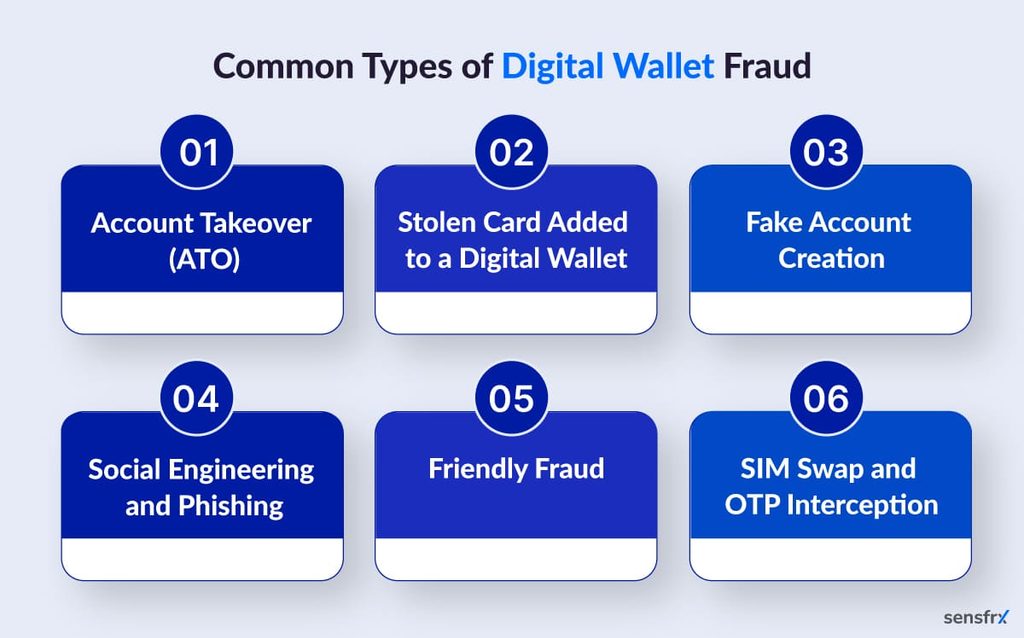
1. Account Takeover (ATO)
Account takeover happens when fraudsters gain access to a customer’s digital wallet using stolen usernames, passwords, or one-time passwords (OTPs). Once inside, they use the saved payment methods to make unauthorized purchases.
A common ATO vector is credential stuffing, where attackers use automated tools to test username and password pairs exposed in previous data breaches against other websites. This attack is particularly effective when customers reuse passwords across multiple services and allows fraudsters to target accounts at scale. Monitoring for patterns such as repeated failed login attempts, unusual login volumes, and other indicators of automated authentication activity can help businesses detect and block credential-stuffing attacks before they result in account takeover.
Example: A customer’s PayPal account is compromised through a phishing email. The attacker logs in and orders expensive electronics using the saved payment details.
Business Impact
- Chargebacks and refund requests
- Customer complaints
- Loss of customer trust and brand reputation
2. Stolen Card Added to a Digital Wallet
In this type of fraud, criminals obtain a customer’s stolen credit or debit card details and attempt to add the card to a digital wallet such as Apple Pay or Google Pay. During enrollment, the card is tokenized, meaning the wallet uses a device-specific payment token instead of exposing the underlying card number (PAN) during subsequent transactions.
The key fraud risk, therefore, is not breaking the wallet’s tokenization. It is fraudulently enrolling the stolen card in the first place. If an attacker successfully completes the card-enrollment process, they can obtain a tokenized payment credential and use it for unauthorized purchases before the legitimate cardholder or issuer detects the fraud. This makes card verification and risk assessment at the time of wallet enrollment a critical control point for preventing this type of attack.
Example: A fraudster adds stolen card details to Apple Pay and places multiple orders from an online store.
Business Impact
- Fraudulent orders
- Payment disputes and chargebacks
- Revenue loss
3. Fake Account Creation
Fraudsters create digital wallet or customer accounts using fake or stolen identities. These accounts are often used to abuse discounts, sign-up bonuses, loyalty rewards, or to hide other fraudulent activities.
Example: A fraudster creates dozens of fake accounts to claim a “₹500 off on your first purchase” offer multiple times.
Business Impact
- Promotional and loyalty program abuse
- Increased fake customer accounts
- Revenue loss from abused offers
4. Social Engineering and Phishing
Fraudsters trick customers into revealing their wallet login credentials or OTPs through fake emails, SMS messages, phone calls, or websites. Once they gain access, they make unauthorized transactions.
Example: A customer receives a fake message claiming their wallet account needs verification. After entering their login details on a fake website, the fraudster accesses the account and starts making purchases.
Business Impact
- Unauthorized transactions
- Customer complaints
- Loss of customer confidence
5. Friendly Fraud
Friendly fraud occurs when a customer makes a legitimate purchase but later disputes the transaction, claiming it was unauthorized or that they never received the order. This may be intentional or the result of a misunderstanding.
Example: A customer receives a product purchased using Google Pay but later files a chargeback claiming they never approved the payment.
Business Impact
- Chargebacks
- Lost revenue
- Increased operational costs to investigate disputes
6. SIM Swap and OTP Interception
Fraudsters convince a mobile carrier to transfer a victim’s phone number to a SIM card they control, often using social engineering or stolen personal details. Once the number is theirs, they intercept the OTPs that wallets send to verify logins and transactions, and use them to bypass authentication entirely. This type of fraud is especially relevant for mobile-first wallets like PhonePe and Google Pay, where OTP is often the primary verification step.
Example: A fraudster requests a SIM swap on a victim’s number, receives the next login OTP for their PhonePe account, and transfers the wallet balance before the victim notices their phone has lost signal.
Business Impact
- Bypassed authentication despite “verified” OTP checks
- Difficult-to-trace disputes, since the transaction looks fully authenticated
- Higher scrutiny from payment processors if the pattern repeats
How Digital Wallet Fraud Affects eCommerce Businesses
Digital wallet fraud doesn’t just result in a single fraudulent transaction. It can increase costs, disrupt operations, and damage customer trust.
Financial Losses
Every successful fraudulent transaction can lead to chargebacks, refund requests, lost merchandise, and payment processing fees. These losses can quickly add up, especially for high-value orders. These indirect costs often exceed the value of the original fraudulent purchase. In fact, merchants now lose more than $5 for every $1 of direct fraud loss, highlighting the true financial impact of fraud.
Higher Operational Costs
Your team may spend additional time reviewing suspicious transactions, handling customer complaints, investigating fraud cases, and processing chargebacks, increasing operational expenses. According to Mastercard, each chargeback costs merchants an average of $128 in third-party fees and internal operational costs.
Poor Customer Experience
Fraud prevention measures that are too strict can accidentally block legitimate customers. False declines and additional verification steps may lead to abandoned carts and lost sales. And acquiring new customers is far more difficult than losing an existing customer.
Brand Reputation
Customers expect secure online payments. Frequent fraud incidents can reduce customer confidence, leading to negative reviews and fewer repeat purchases.
Increased Payment Risk
A high number of chargebacks can increase your chargeback ratio, attract closer scrutiny from payment processors, and in severe cases, result in higher processing fees or restrictions on accepting payments. Additionally, the number of chargebacks globally is expected to grow by 37% between 2025 and 2029, increasing the pressure on businesses to proactively manage fraud.
What to Do If You Suspect Digital Wallet Fraud
Even with strong prevention in place, some fraudulent transactions will get through. How your team responds in the first few hours matters almost as much as the controls you have upfront.
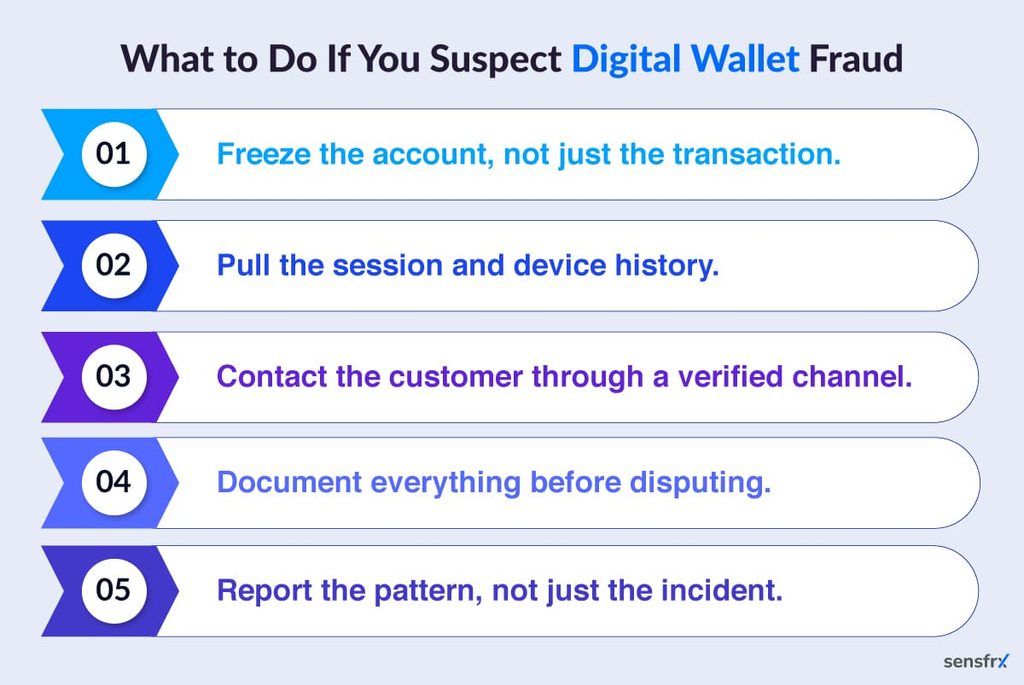
- Freeze the account, not just the transaction. If one order looks fraudulent, assume the account itself may be compromised and pause further activity on it while you investigate.
- Pull the session and device history. Compare the flagged transaction’s device, IP, and login pattern against the customer’s normal behavior to confirm whether this looks like account takeover, a stolen card, or friendly fraud.
- Contact the customer through a verified channel. Use the phone number or email on file from before the suspicious activity, not any contact details submitted with the flagged order.
- Document everything before disputing. Screenshots of device fingerprints, IP logs, and login timestamps strengthen your case if the transaction is challenged or you need to contest a chargeback.
- Report the pattern, not just the incident. If you’re seeing repeated attempts from the same device or IP range, feed that into your fraud rules so the next attempt is blocked automatically rather than caught manually again.
How to Prevent Digital Wallet Fraud?
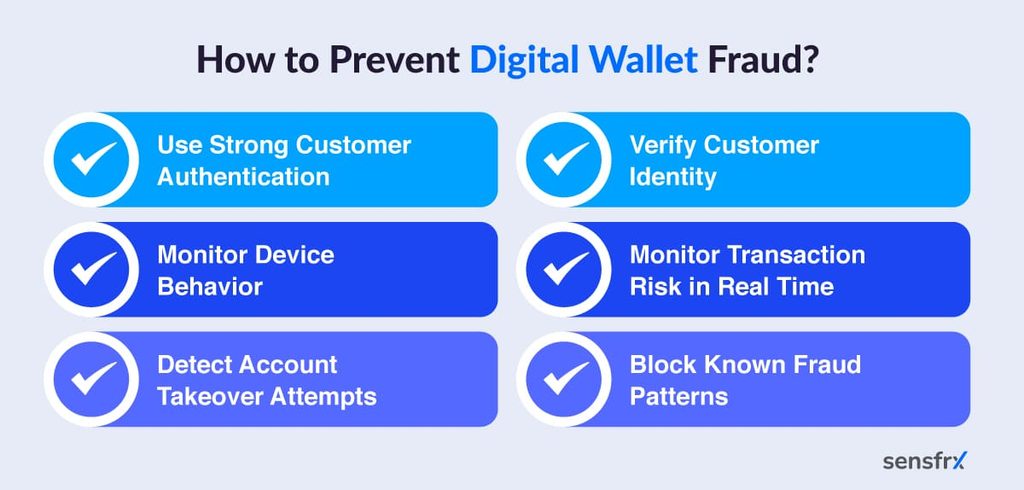
Preventing digital wallet fraud requires a layered approach. Instead of relying only on payment authentication, businesses should monitor users, devices, and transactions throughout the customer journey to detect suspicious activity before a fraudulent purchase is completed.
Use Strong Customer Authentication
Implement strong authentication methods to verify that the person making the purchase is the legitimate account owner.
Best practices include:
- Enable multi-factor authentication (MFA) for customer accounts.
- Support biometric authentication, such as fingerprint or facial recognition, where available.
- Use app-based or push-notification authentication for high-risk logins and transactions, rather than relying on SMS OTP alone. SMS OTPs can be intercepted through SIM swap attacks, so a device-bound authenticator app or push notification is a stronger default for anything high-value.
Monitor Device Behavior
Fraudsters often use different devices or attempt to hide their identity. Monitoring device behavior can help identify suspicious activity before payment is completed.
Look for:
- Changes in device fingerprints
- Emulators or virtual devices used to automate fraud
- Rooted or jailbroken devices that bypass security controls
- Suspicious browser or device configurations
Detect Account Takeover Attempts
Account takeover is one of the most common forms of digital wallet fraud. Detect unusual login activity before fraudsters gain access to customer accounts.
Monitor for:
- Logins from unfamiliar devices or locations
- Impossible travel, where the same account logs in from distant locations within a short time
- Multiple failed login attempts
- Frequent password resets or account recovery requests
Verify Customer Identity
Verify that new and existing customers are genuine, especially during account creation or high-risk transactions.
Consider:
- Email verification
- Phone number verification
- Identity verification for high-value purchases or suspicious activity
Monitor Transaction Risk in Real Time
Evaluate every transaction using multiple risk signals instead of relying only on payment approval.
Analyze:
- Device risk
- IP reputation and geolocation
- Transaction velocity (multiple purchases in a short period)
- Customer behavior, such as unusual spending patterns or checkout behavior
Real-time risk analysis helps stop fraudulent transactions before they are completed while allowing legitimate customers to shop without unnecessary friction.
Block Known Fraud Patterns
Many fraud attempts follow common patterns that can be identified automatically.
Block or flag transactions involving:
- Disposable or temporary email addresses
- VPNs, proxies, and TOR networks
- High-risk IP addresses
- Automated bot traffic
- Repeated attempts from previously identified fraudulent devices
By combining these controls with real-time fraud detection, businesses can significantly reduce digital wallet fraud while maintaining a smooth checkout experience for genuine customers.
Conclusion
Digital wallet fraud is evolving, making real-time fraud detection essential. Combining device intelligence, behavioral analysis, IP intelligence, and risk scoring helps businesses identify suspicious activity early without adding unnecessary friction for genuine customers.
With Sensfrx, businesses can monitor transactions in real time, detect risky activity, and strengthen fraud prevention while keeping checkout seamless. Contact the Sensfrx team and start protecting your business.
Frequently Asked Questions (FAQs)
What is digital wallet fraud?
Digital wallet fraud occurs when criminals exploit digital payment wallets to make unauthorized transactions, steal payment information, take over accounts, or abuse wallet features. Common methods include account takeover, stolen credentials, social engineering, device compromise, and fraudulent transactions.
What are the most common types of digital wallet fraud?
Common types of digital wallet fraud include:
• Account takeover (ATO): Attackers gain unauthorized access to a wallet account.
• Stolen payment credentials: Criminals use compromised card or bank details.
• Social engineering: Victims are tricked into revealing OTPs, PINs, or login credentials.
• Device compromise: Malware or other attacks allow criminals to access wallet-related information.
• Synthetic identity fraud: Fraudsters create fake identities using a combination of real and fabricated information.
• Unauthorized transactions: Criminals use a compromised wallet to make fraudulent purchases or transfers.
How do fraudsters gain access to digital wallets?
Fraudsters commonly use credential stuffing, phishing, social engineering, malware, SIM-swap attacks, and stolen credentials. They may also exploit weak authentication or compromised devices to bypass security controls and take over wallet accounts.
How can digital wallet fraud be detected?
Digital wallet fraud can be detected by monitoring behavioral and transactional signals such as unusual login locations, new devices, rapid changes in account behavior, abnormal transaction amounts, repeated failed authentication attempts, and unusual transaction velocity. Combining these signals with device, IP, identity, and behavioral analysis can improve detection accuracy.
How does device fingerprinting help prevent digital wallet fraud?
Device fingerprinting creates a unique profile based on characteristics of a user’s device and environment. It can help identify whether a transaction or login originates from a familiar device, a new device, or a device associated with suspicious activity. This provides an additional signal for detecting account takeover and fraudulent transactions.


