Imagine thousands of payment attempts hitting your checkout page, but not from customers, but from bots trying to identify valid payment cards. Every failed authorization increases processing costs, while every successful one brings attackers one step closer to committing payment fraud.
This is a BIN attack. By combining a valid Bank Identification Number (BIN) with automated bots, cybercriminals can test thousands of card combinations against vulnerable ecommerce stores in minutes. As these attacks become more sophisticated and AI-driven, they are increasingly difficult to detect using traditional fraud controls.
In this guide, you’ll learn what a BIN attack is, how it works, how to detect it early, and the most effective strategies to prevent it before it impacts your business.
What Is a BIN Attack?
A BIN attack is an automated payment fraud technique in which attackers generate numerous possible payment card numbers based on a known Bank Identification Number (BIN) and attempt to validate them through online payment systems.
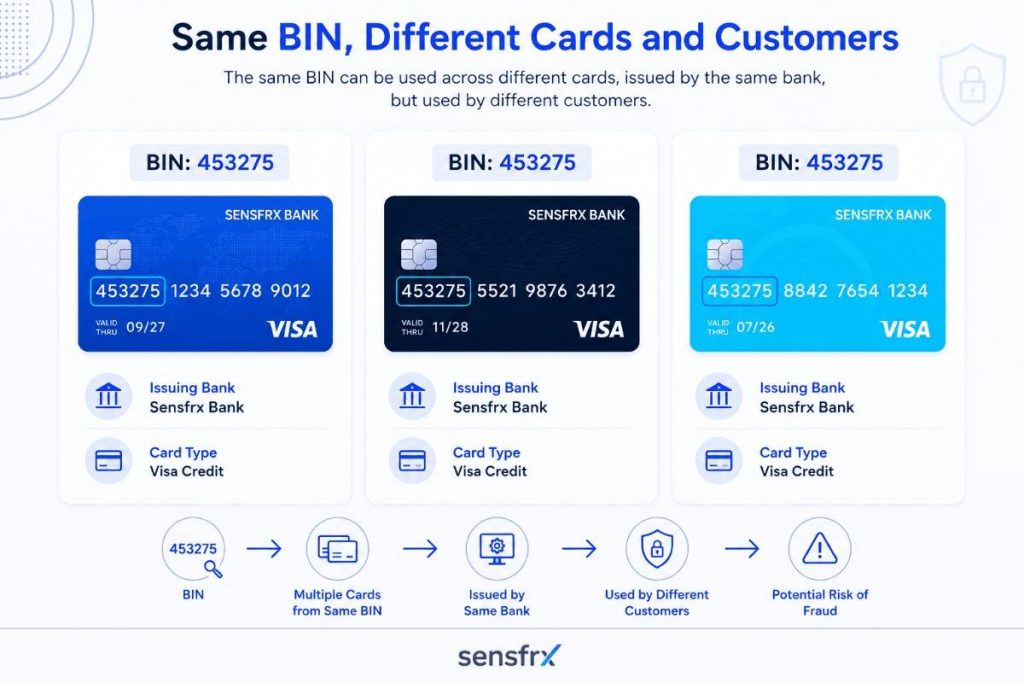
Rather than stealing complete card information one card at a time, attackers exploit the predictable structure of payment card numbers. Once they identify a legitimate BIN, they can generate thousands or even millions of potential card combinations.
Specialized bots then test these generated numbers against online merchants that have weak fraud detection or insufficient payment controls.
The objective is not always to complete a purchase immediately. Instead, attackers often seek answers to questions such as:
- Is the card active?
- Has the card expired?
- Is the CVV correct?
- Will the issuing bank authorize the transaction?
- Does the merchant reveal useful error messages?
- Can the payment gateway be abused for large-scale testing?
Once attackers identify working cards, they can:
- Purchase high-value goods.
- Buy gift cards or digital assets.
- Conduct account takeover campaigns.
- Sell validated cards on underground marketplaces.
- Launch larger payment fraud operations.
For this reason, BIN attacks are often considered the first stage of broader financial fraud rather than the end goal.
What Is a BIN?
A Bank Identification Number (BIN), also known as an Issuer Identification Number (IIN)—is the first 6 to 8 digits of a payment card.
These digits identify the organization that issued the card and provide key information used during payment authorization.
A BIN can indicate:
- Card issuer
- Card network
- Card type
- Country of issuance
- Financial institution
- Debit or credit classification
- Business or consumer card
For example:
Card Number
453981 XXXX XXXX XXXX
XXXX
BIN / IIN
Payment gateways use the BIN to route authorization requests to the correct issuing bank.
Anatomy of a Payment Card Number
A standard payment card contains several components:
| Component | Purpose |
| BIN (First 6–8 digits) | Identifies the issuing institution |
| Account Identifier | Unique account number |
| Check Digit | Mathematical validation using the Luhn algorithm |
Because the BIN portion is publicly identifiable and follows standardized formats, attackers only need to guess the remaining digits rather than an entirely random card number.
This dramatically reduces the complexity of generating candidate card numbers.
Why BIN Ranges Matter to Attackers
Payment issuers allocate BIN ranges in predictable blocks.
If criminals know a valid BIN belongs to a particular issuer, they can generate large numbers of candidate cards that resemble legitimate payment cards.
For example:
4539811234567890
4539816543781255
4539819988776654
4539815678123499
All share the same BIN but represent different account numbers.
Most generated numbers will be invalid.
However, automation allows attackers to test millions of combinations rapidly, making even a tiny success rate profitable.
How BIN Attacks Work
Although every attack varies, most BIN attacks follow a predictable lifecycle.
Understanding each phase helps merchants implement controls at multiple points rather than relying on a single defense. Detecting reconnaissance, limiting automated testing, and analyzing payment behavior early can prevent attackers from ever reaching the monetization stage.
Stage 1: Reconnaissance
Attackers first identify potential targets.
They look for:
- Ecommerce websites with minimal fraud controls
- Public payment APIs
- Checkout pages lacking rate limiting
- Merchants with detailed payment error messages
- Businesses selling digital goods or low-cost items
The goal is to find environments where repeated payment attempts can occur without triggering security controls.
Stage 2: BIN Discovery
Next, attackers collect valid BIN ranges.
Sources may include:
- Public BIN databases
- Previously compromised cards
- Data breaches
- Underground forums
- Dark web marketplaces
- Open-source intelligence (OSINT)
The BIN itself is not secret. The challenge is discovering valid account numbers associated with it.
Stage 3: Card Number Generation
Using the identified BIN, attackers generate thousands or millions of possible card numbers.
Generation software automatically:
- Creates account identifiers
- Calculates valid Luhn check digits
- Produces mathematically valid payment cards
This process is fully automated and can generate candidate cards in seconds.
Stage 4: Bot Automation
Manual testing would be impractical.
Instead, attackers deploy bots that can:
- Rotate IP addresses using residential proxies
- Mimic browser behavior
- Randomize headers
- Distribute requests across cloud infrastructure
- Evade simple rate limits
- Retry failed requests intelligently
Modern bot frameworks can submit thousands of payment attempts per minute while appearing to originate from legitimate users.
Stage 5: Payment Testing
The bots submit low-value transactions through online checkout pages or payment APIs.
Typical tests include:
- $0 authorizations
- $1 verification charges
- Small digital purchases
- Donation forms
- Subscription sign-ups
- Gift card purchases
Attackers intentionally keep transaction values low to reduce scrutiny from fraud systems and increase the likelihood of authorization.
Stage 6: Validation
The responses reveal valuable information.
Examples include:
- Card valid
- Incorrect CVV
- Expired card
- Insufficient funds
- Do not honor
- Issuer unavailable
Even failed transactions help attackers refine their datasets and identify cards worth further testing.
Stage 7: Monetization
Validated cards become valuable assets.
Attackers may:
- Purchase high-value merchandise
- Buy cryptocurrency
- Acquire gift cards
- Sell validated cards on underground markets
- Conduct cash-out operations
- Support broader fraud campaigns such as account takeover or synthetic identity fraud
At this stage, the BIN attack transitions from reconnaissance to financial exploitation.
Business Impact of BIN Attacks
Most merchants only notice a BIN attack when chargebacks start arriving. By then, the damage is already done.
The real cost runs deeper than fraud losses alone:
| Impact | What It Means for Your Business |
| Chargebacks | Excessive chargeback ratios trigger higher processing fees, monitoring programs, and risk of merchant account suspension |
| Authorization fees | Every failed attempt costs money. Thousands of bot-driven requests add up fast |
| False declines | Overly aggressive fraud controls block legitimate customers, increasing cart abandonment |
| Operational load | Fraud investigations pull teams away from revenue-generating work |
| Brand reputation | Repeated payment issues erode customer trust and drive negative reviews |
| PCI DSS scrutiny | Ongoing fraud incidents can trigger compliance reviews and reassessment of payment security controls |
The hidden cost most merchants underestimate is authorization abuse. A large BIN attack can generate tens of thousands of payment requests in hours, running up gateway fees without a single successful fraudulent purchase being completed.
How to Detect BIN Attacks Before They Cause Fraud
One of the biggest challenges with BIN attacks is that they often resemble legitimate customer activity. A single authorization attempt rarely looks suspicious. The real signal emerges when hundreds or thousands of seemingly unrelated transactions are analyzed together.
Effective detection requires correlating multiple signals in real time.
1. Velocity Monitoring
Velocity monitoring is one of the most effective methods for identifying BIN attacks.
For example:
- Multiple payment attempts from a single IP address within one minute
- Numerous card numbers submitted from the same device
- Repeated authorization attempts using the same BIN
- A sudden spike in failed transactions
- Multiple customer accounts sharing the same device fingerprint
A merchant that normally processes 20 payment attempts per minute but suddenly receives 500 authorization requests should treat this as a potential fraud event, even if the individual transactions appear legitimate.
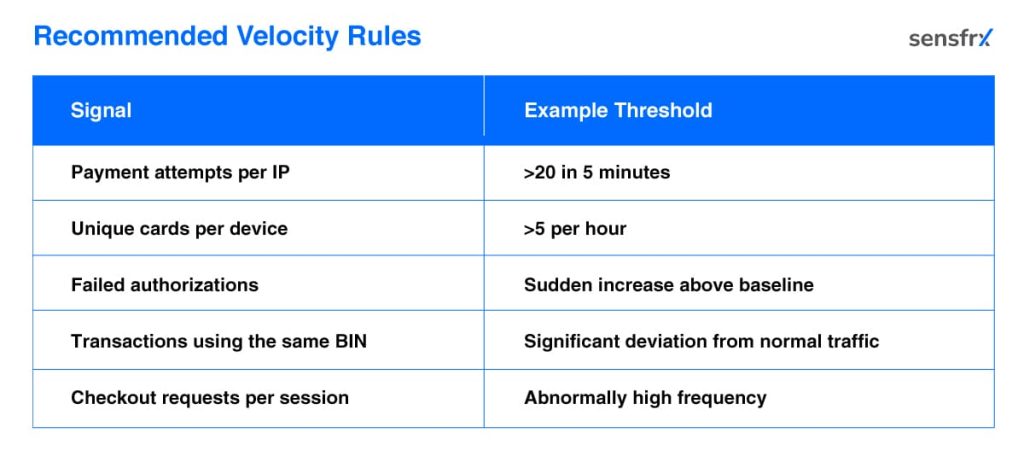
Recommended Velocity Rules
Velocity thresholds should be adaptive and based on normal business patterns rather than fixed values as shown in the image below:
2. Behavioral Analytics
Behavioral analytics focuses on how users interact with your website, not just what they submit.
Unlike humans, bots typically exhibit highly consistent and repetitive behavior.
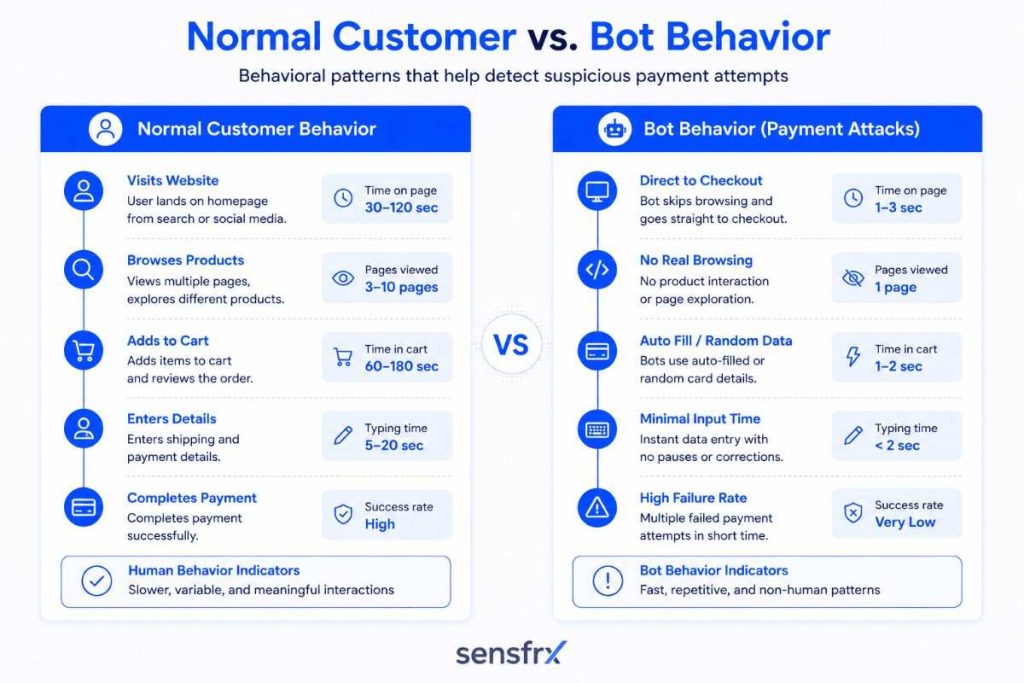
Indicators include:
- Extremely fast page navigation
- Instant form completion
- No mouse movement
- No scrolling behavior
- Uniform typing speed
- Repetitive checkout sequences
- Identical browsing paths
Behavioral analytics platforms build a baseline of legitimate customer activity and flag interactions that deviate significantly from expected patterns.
This helps identify automated payment testing even when attackers rotate IP addresses or spoof browser information.
3. Device Fingerprinting
Attackers frequently change IP addresses using VPNs or residential proxies. However, changing a device’s underlying characteristics is much more difficult.
Device fingerprinting creates a unique profile using attributes such as:
- Browser configuration
- Operating system
- Screen resolution
- Installed fonts
- Language settings
- Time zone
- Hardware characteristics
- Canvas rendering
- WebGL information
Even if an attacker changes their IP address, the same device fingerprint may continue to appear across multiple transactions.
This enables merchants to detect coordinated fraud campaigns that would otherwise appear unrelated.
4. Bot Detection and Automation Analysis
Most large-scale BIN attacks rely on automated tools.
Modern bot management solutions analyze signals such as:
- Browser integrity
- Headless browser detection
- Automation frameworks
- JavaScript execution
- Human interaction patterns
- Request timing consistency
- Browser challenges
Bots increasingly attempt to imitate legitimate users, making advanced bot detection an essential layer of defense.
5. IP Reputation and Proxy Detection
Not all IP addresses present the same level of risk.
Fraud detection platforms evaluate whether requests originate from:
- Known malicious IP addresses
- Data centers
- VPN providers
- Anonymous proxy services
- Tor exit nodes
- Residential proxy networks
6. Geographic and Transaction Intelligence
Geographic anomalies can reveal fraud activity.
Examples include:
- Hundreds of payment attempts originating from countries where the business has no customers
- A customer’s account logging in from multiple continents within minutes
- Rapid switching between unrelated geographic regions
Context matters. A single international purchase may be legitimate, while a sudden surge in geographically inconsistent transactions may indicate automated fraud.
7. Risk Scoring
Rather than making decisions based on a single rule, advanced fraud prevention platforms assign each transaction a risk score.
The score is calculated using multiple signals, including:
- Device reputation
- BIN risk
- IP intelligence
- Velocity metrics
- Behavioral analysis
- Email reputation
- Phone reputation
- Geographic consistency
- Historical purchasing patterns
- Payment history
For example,the risk score can be calibrated as described in below image:
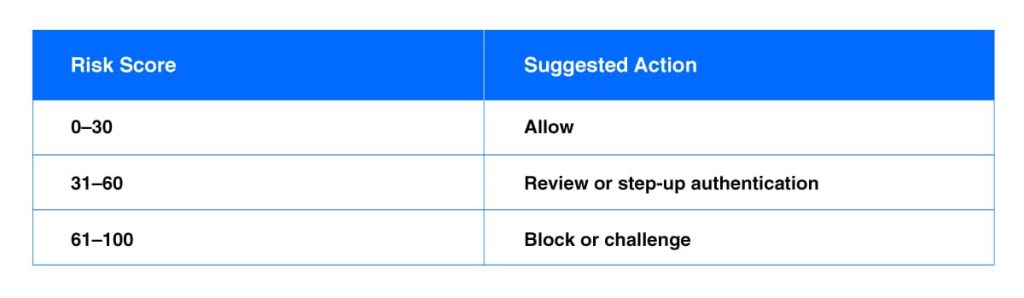
Risk scoring enables merchants to reduce fraud while minimizing false positives.
8. Payment API Monitoring
Many BIN attacks target payment APIs directly rather than web interfaces.
Security teams should monitor APIs for:
- Unusual request rates
- Repeated authorization failures
- Unexpected HTTP response patterns
- Invalid parameter combinations
- Token reuse
- Suspicious API clients
API-specific logging and alerting provide visibility into attack activity that may never appear in traditional web logs.
Incident Response Playbook for BIN Attacks
Despite implementing strong preventive controls, no ecommerce business can assume it is immune to BIN attacks. The difference between a minor incident and a major financial loss often comes down to how quickly the attack is detected and contained.
A well-defined incident response plan enables fraud teams, security analysts, payment operations, and developers to coordinate effectively while minimizing business disruption.
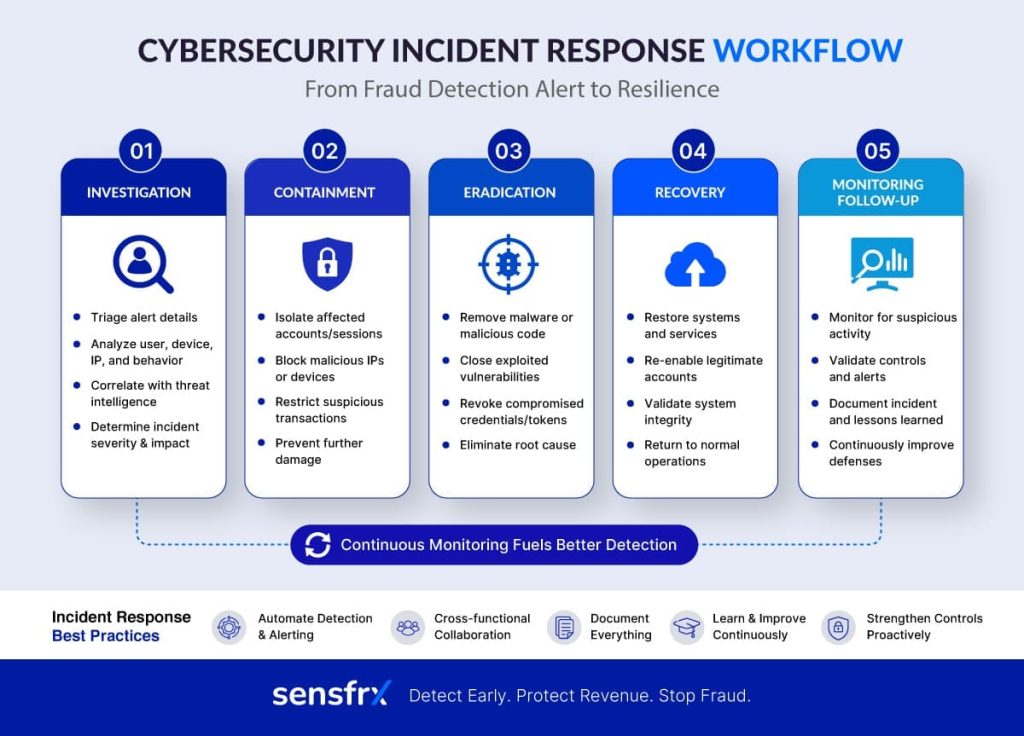
Step 1: Confirm the Attack
Before taking action, validate whether the activity is genuinely indicative of a BIN attack rather than a seasonal sales spike or marketing campaign.
Look for indicators such as:
- Sudden increase in payment authorization requests
- Multiple payment attempts using the same BIN range
- High decline rates across different card numbers
- Numerous low-value transactions
- Increased CVV or AVS failures
- Unusual traffic from residential proxies, VPNs, or cloud providers
- Similar device fingerprints across multiple accounts
Correlating multiple indicators reduces the risk of false alarms.
Step 2: Contain the Attack
Once a BIN attack is confirmed, focus on limiting further abuse while maintaining service availability for legitimate customers.
Immediate containment measures include:
- Enable stricter rate limiting on checkout and payment APIs.
- Temporarily increase fraud risk thresholds.
- Require CAPTCHA or bot challenges for suspicious traffic.
- Block known malicious IP addresses and autonomous system numbers (ASNs).
- Restrict requests from high-risk geographies if appropriate.
- Increase step-up authentication (such as 3D Secure) for elevated-risk transactions.
- Tighten velocity rules for payment attempts.
The objective is to disrupt automated testing without significantly affecting genuine shoppers.
Step 3: Investigate the Scope
Determine the extent of the attack by analyzing payment logs, fraud alerts, and infrastructure telemetry.
Questions to answer include:
- Which BIN ranges were targeted?
- How many payment attempts occurred?
- Were any fraudulent transactions approved?
- Which payment channels were affected (web, mobile, API)?
- Were multiple customer accounts involved?
- Did attackers exploit a specific vulnerability or misconfiguration?
Comprehensive logging is essential for accurate root cause analysis.
Step 4: Coordinate with Payment Partners
Notify relevant stakeholders, including:
- Payment gateway providers
- Acquiring banks
- Card networks (when appropriate)
- Fraud prevention vendors
- Internal finance and customer support teams
Payment partners may identify similar attacks affecting other merchants and recommend temporary controls or network-level mitigations.
Step 5: Recover Securely
Once malicious traffic subsides:
- Gradually restore normal fraud thresholds.
- Continue enhanced monitoring for recurring activity.
- Review blocked transactions to minimize false positives.
- Validate that security controls are functioning as expected.
Avoid immediately removing all temporary restrictions, as attackers often retry after initial defenses are relaxed.
Step 6: Conduct a Post-Incident Review
Every fraud incident provides valuable lessons.
A post-incident review should document:
- Timeline of events
- Detection methods
- Response actions
- Financial impact
- Control gaps
- Lessons learned
- Recommended improvements
This information helps strengthen future detection capabilities and incident response processes.
Summary of BIN Attack Response Steps
The following table summarizes the key phases involved in investigating, containing, recovering from, and preventing a BIN attack.
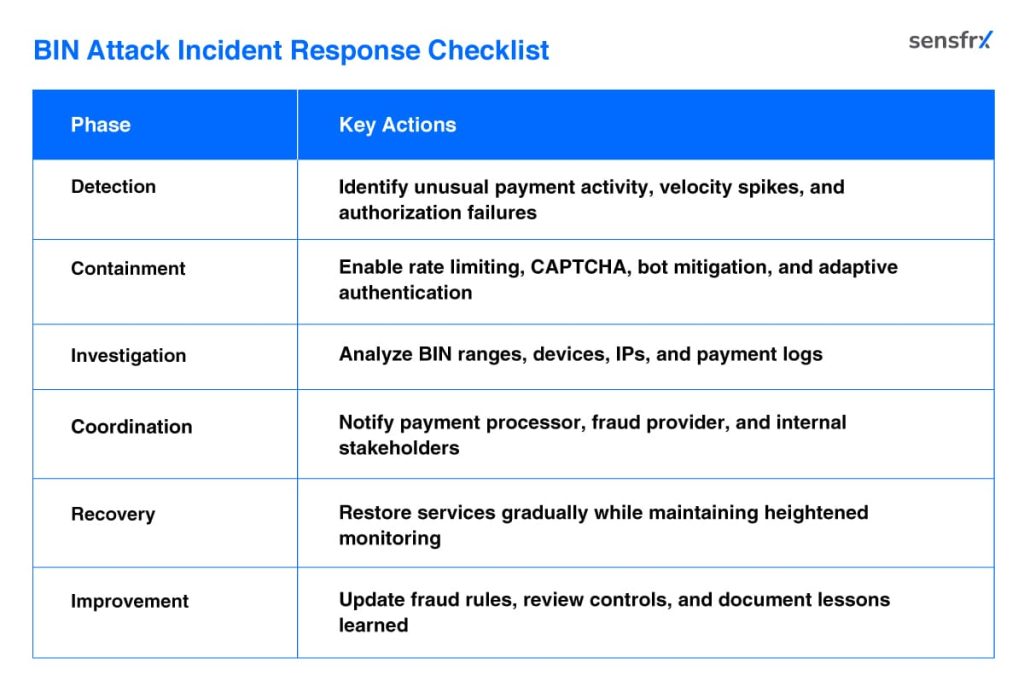
Merchant Security Checklist for BIN Attack Prevention
Preventing BIN attacks requires more than a single security control. As attackers increasingly use bots, residential proxies, and AI-driven automation, merchants must adopt a layered fraud prevention strategy that combines payment security, bot mitigation, device intelligence, behavioral analytics, and continuous monitoring.
The following checklist provides practical actions that ecommerce businesses, payment teams, and security professionals can implement to strengthen their defenses and reduce the risk of automated card testing attacks. Use it as a reference to assess your current security posture and identify areas for improvement.
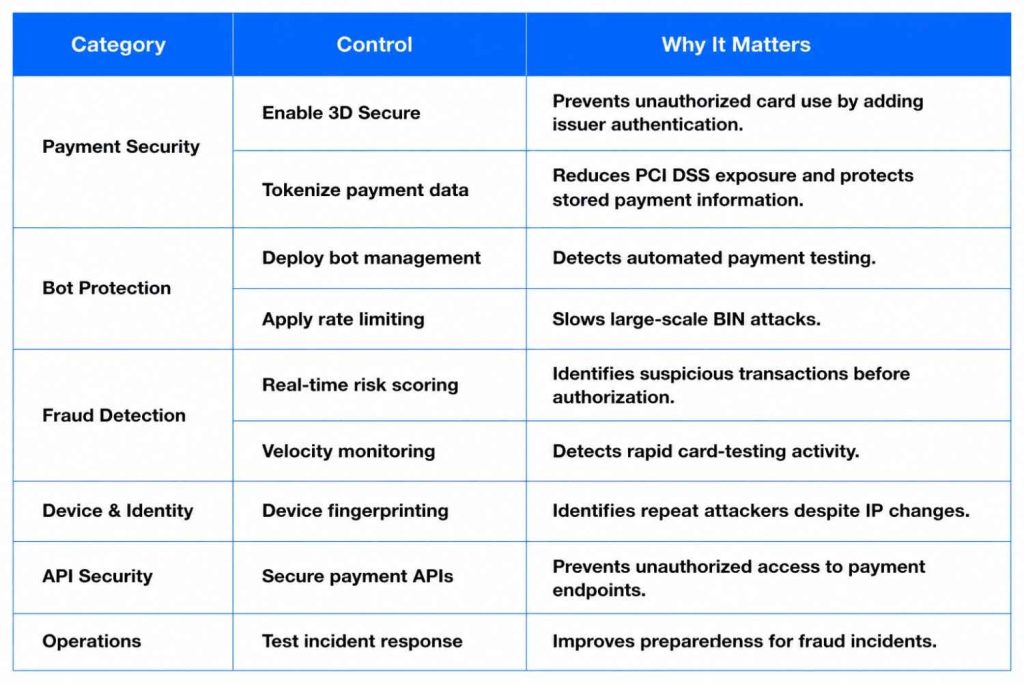
By combining payment security, bot mitigation, device intelligence, behavioral analytics, and real-time risk scoring, merchants can significantly reduce the success of BIN attacks while maintaining a secure and seamless checkout experience for legitimate customers.
Conclusion
BIN attacks have become increasingly sophisticated, leveraging bots, AI, and distributed infrastructure to automate large-scale payment fraud. Protecting against these attacks requires more than isolated security controls—it demands a layered approach that combines behavioral analytics, device fingerprinting, bot detection, real-time risk scoring, intelligent policy enforcement, and continuous monitoring.
Platforms like Sensfrx help merchants stay ahead of evolving fraud by analyzing hundreds of risk signals in real time to detect and stop BIN attacks before they result in financial losses. By enabling merchants to intelligently allow, challenge, review, or block suspicious transactions while minimizing friction for genuine customers, Sensfrx helps strengthen payment security, reduce chargebacks, and build a more secure and trusted ecommerce experience.
Want to see how your checkout performs against automated BIN attacks? Book a free trial to see how Sensfrx detects bot-driven payment fraud in real time.
What is a BIN attack?
A BIN attack is a type of payment card fraud where attackers generate and test large numbers of card numbers that share the same Bank Identification Number (BIN). They use automated bots to identify valid card details and later use them for unauthorized purchases or fraud.
How do attackers obtain valid card details during a BIN attack?
Attackers start with a known BIN and use automated scripts to generate possible card numbers. They then perform small authorization attempts across multiple merchants to determine which card numbers, expiration dates, and CVV combinations are valid.
What are the warning signs of a BIN attack?
Common indicators include a sudden spike in failed payment attempts, numerous low-value transactions, repeated payment attempts from the same IP or device, high authorization decline rates, and unusual transaction patterns targeting specific card issuers.
How can businesses prevent BIN attacks?
Businesses can reduce BIN attack risk by implementing velocity checks, device fingerprinting, bot detection, risk-based authentication, rate limiting, real-time fraud monitoring, and 3D Secure for high-risk transactions. Monitoring payment authorization trends also helps identify attacks early.
Which industries are most vulnerable to BIN attacks?
Industries that process high volumes of online card payments are the most frequently targeted, including eCommerce, digital subscriptions, travel and hospitality, gaming, ticketing platforms, food delivery services, and digital goods marketplaces.
What is the difference between a BIN attack and card testing?
A BIN attack focuses on generating and validating card numbers based on a specific BIN, while card testing uses previously stolen card details to verify whether compromised cards are still active. Although both involve small authorization attempts, their methods for obtaining card information differ.